
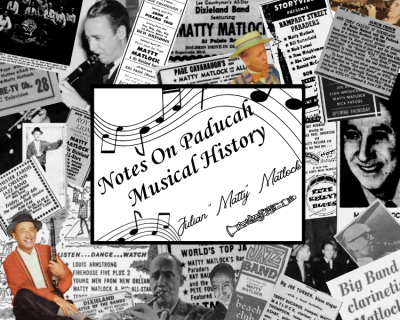
Paducahan Matty Matlock was a jazz musician and arranger who performed with Bob Crosby and his Bob Cats, Louis Armstrong, Judy Garland, Bing Crosby and more. He made 5 albums as Matty Matlock and the Paducah Patrol for Warner Brothers and contributed to hundreds of other recordings. - Nathan Lynn, Local and Family History
Julian Clifton Matlock was born in Paducah, KY, April 27, 1907, to George A. and Azilee Matlock. George was a stonecutter, and the family spent most of Julians early life in Paducah, save for a short stint in Detroit, MI. Julian’s first reported stage performance appeared in the 1915 Paducah Sun where he was noted as reciting, “Today is the Time to Begin,” at Fountain Avenue Methodist Church. He later noted his musical career began in a Paducah Boy Scout Band. Around 1917 the family moved to Nashville, TN. By September of 1918 they were living at 513 Demonbreun St and by 1920 in East Nashville, where Azilee worked sales at a music store.1
“My mind was on music most of the time, even when I was serving or helping to restock the shelves. The store sold Paramount records, but they didn't have anything to play them on, so I took them home to listen to them. They struck my fancy. There was something there that I liked,” Matlock noted.2
The April 1, 1923, Nashville Tennessean listed Julian as performing “Love’s Dream,” on clarinet, at his alma mater, Hume-Fogg High School, where he was involved in music and quartet. He soon took his first ‘long pants engagement,’ with the Blue Melody Players. Sometime in the mid 1920s he spent time in New Orleans, noting, “New Orleans was a wonderful place for a musician. Everyone was a jazzman, even if he could do no more than whistle. More than one jazz standard was first hummed by a cabbie, bartender, or whoever. A musician would hear it, play it, work it out. And there are many top jazz musicians who never attained national recognition because they just couldn't bring themselves to leave that city.”3
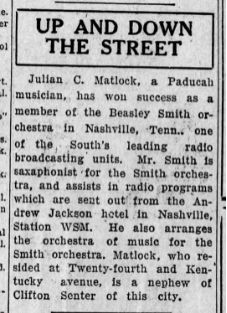
By October he was performing saxophone with the Beasley Smith Orchestra and in February 1926 the Paducah Evening Sun reported that Matlock, “a Paducah musician,” had joined the group fulltime as an arranger. After leaving Paducah, Julian continued to hold ties to the city, returning numerous times to visit family.
Smith’s orchestra was known for broadcasting on WSM from the Andrew Jackson Hotel but spent the summer of 1927 at Lake Pau Pau, Michigan where Matlock would travel to Chicago on off days. “It was a fantastic experience, to hear so much music in one night. Benny Goodman being featured with Pollack (Ben Pollack Band), Louis (Armstrong) and Earl Hines playing duets, unbelievably good.”4
In 1928, Matlock joined Jimmy Joy for a short time with whom he made his recording debut that year in Chicago. He quickly rejoined Beasly Smith and did some work with the Tracy-Brown Band until October 1929 when he at the age of 22, joined the Ben Pollack Orchestra, replacing the great Benny Goodman. He performed clarinet, alto-sax, and arranged for the group. “I was in seventh heaven, but at the same time I was scared about taking Benn Goodman’s place, it all worked out, and I joined Pollack, who was really a grand person.”5
The orchestra traveled the U.S. and in mid-January of 1930, recorded the single, “I’m Following You,” in New York. It was during this time that he started to focus on developing his skill as an arranger, taking inspiration from Fud Livingston. He formed lifelong friendships with players like Eddie Miller, Nappy LaMare, Gil Rodin, and Jack Teagarden. They recorded and toured for many years before settling in for a season at the Cotton Club in Culver City, CA, where Matlock and other disgruntled bandmates parted ways with Pollack. Matlock, Miller, LaMare, and Rodin, reformed under the direction of Bob Crosby in 1935, with the new stipulation that all the arrangements had to swing. The band had left the dry scene of the West coast for New York City and made its first recordings that year in June. They also played the Roseland Ballroom and toured the country performing in North Carolina, Georgia, Texas, and a closing stint in Cincinnati, OH. 6
While Matlock’s professional career was on the rise, so was his personal life. He married Tennessean and Vanderbilt grad Lura Beasley around the turn of the decade and in 1930 the couple welcomed their son Julian Jr. In 1935 they resided in Queens, New York and in 1936 his daughter Anne was born. They would go on to have William (1942) and Margaret (1947). While in New York he heard the great bands of Fletcher Henderson, Chick Webb and Don Redman. He also found southern food and witnessed James Jonson and Willie Smith stride piano cutting contest.7
By 1936, Bob Crosby and his Bob Cats were making a name for themselves, though Matlock resented the term, “Dixieland,” and the conformities of record companies. While the band performed during the first of the year in Florida, Matty stayed in New York, closer to his family, and worked arranging material for the band. That year they recorded 4 sides with Decca. One writer crediting Matty as the “greatest ‘find’ of the season.” Matlock also recorded some swinging notes on Decca 848 backing Judy Garland on, “Stompin at the Savoy,” and “Swing Mister Charlie.” Matlock was finding a home in the studio as a supporting artist as well as with the Bob Cats.
February of 1937 found Matty improvising on, “The Old Spinning Wheel,” alongside the Bob Cats. That November, they recorded in Los Angeles with Connie Boswell on, “Martha,” and “Home on the Range.” After touring Pittsburg, Minneapolis, St. Louis, Houston, Memphis and Dallas, it was agreed upon that Matty return to New York and work as the band's arranger. He worked with Ray Noble’s Orchestra at Rainbow Grill, and was close to his family. Between 1930 and 1939, Matlock is credited with 29 studio credits supporting the numerous previously mentioned acts along with Wingy Mannone and others. It was during this time that Julian started using “Matty” as his professional name. 8

In 1939, the band and Matlock were as busy as ever. Matty had struggled to keep his embouchure up as an arranger and took the chance to play whenever he could, including a jam session with Count Baises’ Band at the Howard Theater early in the year. The group also began working on Camal Caravan, a CBS show, and saw large success basing themselves back out of New York. Matty returned to saxophone during this time and used his newer notoriety to visit with Sidney Bechet, presenting him with a soprano sax. He continued to gain attention as an arranger, and it's noted that by 1940 he “isn't seen when the orchestra plays, nor is he behind any instrument...” Matlock noted, “The arranger must live with a band. He must know the musical and personal quirks of every fellow in the gang. Armed with this knowledge, the arranger can play around with the music so as to get the best effects. Our ‘Dixieland’ style music depends on the arrangements. The ‘two beat and four beat’ mixed lift we give the music, plus the use of varied figures and chord progressions, enrichen a song, and keep it to its practical purpose-providing good dance music. Much of modern ‘ho’ swing is a performer's show, played for effect. We have to go back to early jazz for the purest un-self-conscious jazz-music. The very simplicity of old ballads, for example, lends itself to variegated jazz treatment. My idea of the ideal orchestra is a bunch of musicians playing together for the total effect-not a lot of individual performers longing for the spotlight.”9
In 1940, Matty and his family were living in Chicago, and he listed his occupation as a music arranger. Camal Caravan was paying well, although Matty was reportedly not always paid for his work for the corporation as a sideman. The Crosby band's years of hard work had shown some rewards. It was reported in Down Beat Magazine that Matlock and other corporate sidemen made an estimated $15,000 in 1940. January of that year saw the band working a 6-week stint at the Blackhawk in Chicago where Doris Day sang a number of shows with the band. In October of 1940 on his WWII Draft Registration card, Matty listed working for Bob Crosby at MCA 745 5th Ave NY, NY, but registered in Los Angeles. At the time he was arranging and doubling on clarinet and saxophone. The same year Crosby himself acknowledged Matlock's contribution while on the Camal Caravan, stating, “Matty's country clarinet in this Dixieland arrangement are something without which we never want to be. Matty's latest contribution is a blues called "That's What I'm Talkin' About, Mama." It's Matty's own arrangement, and you'll hear his clarinet in the second chorus." Matlock provided numerous popular songs to Crosby’s band including, “March of the Bobcats,” and “Paducah Parade.” Unfortunately, the band's stint on the show ended later that year. The Bob Cats closed out 1940 at the Mark Hopkins Hotel in San Francisco that December.10
The group found steady work in the Hollywood film industry on projects like the Holiday Inn, Reville with Beverly, Presenting Lily Mars. 1942 saw them recording their own sides most notably for Matlock's sake, the “Jimtown Blues,” where Matlock shines. They also backed Bing Crosby, Fred Astaire, Margaret Lenhart, and others, but the band was changing with World War II. On July 30th of 1942 they recorded their last session together, backing singer Mary Lee. They toured Omaha, Minneapolis, Milwaukee, Chicago, Detroit, Cleveland, Buffalo, Mewar, Philadelphia, and Boston to close out the year, and a couple of California dates in early 1943.
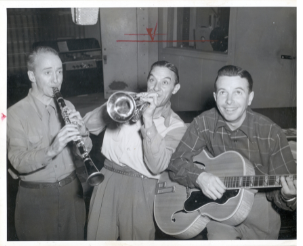
By 1943 Matty’s family had moved to North Hollywood, Studio City, CA where they would reside for the rest of their lives. With the onset of the US entering WWII, Eddie Miller took over the Bob Cats and Matty continued as arranger. The band performed primarily around Los Angeles. Matlock’s career began to shift away from a traveling musician, and he found his place within the booming entertainment industry in Hollywood, allowing him to be at home with his family while maintaining his career. He collaborated with Jack Teagarden, Billy May, and Bobby Hackett on numerous projects and recorded with the likes of Phil Harris, Red Nichols, and Ray McKinley, among others. Discogs credits him with contributing to 67 recordings from 1940-1949, including Bing Crosby, Pee Wee Hunt, and La Vere’s Chicago Looper’s. On September 12, 1947, he recorded with collaborator Paul Weston as part of the reed section on Capitol Session #695, Record #15003, at Radio Recorders, 7000 Santa Monica Boulevard, Los Angeles. The session featured notables Benny Goodman, Johnny Mercer, Peggy Lee, Margaret Whiting, The Pied Pipers and more, on two sides, “The Freedom Train,” and “God Bless America.” 11
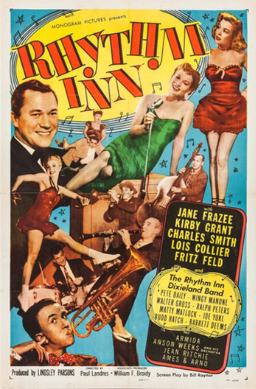
The 1950s would prove to be the busiest of his career in terms of studio work with Discogs crediting him with 141 citations. He regrouped with his old band leader Ben Pollack and began recording as the leader of the Matty Matlock All Stars. The same year, Matlock appeared in the Monogram Pictures film Rhythm Inn, performing clarinet on and off screen as part of the Dixieland band. In 1951 Decca released Bing Crosby (Bob’s brother) With The Mellomen And Matty Matlock And His Orchestra, “With My Shillelagh Under My Arm,” and “St. Patrick's Day.” On April 27th Matty recorded sax and clarinet with Louis Armstrong, Bing Crosby, Red Nichols and others, on the tune “Gone Fishin.” He would work on Bing’s radio show throughout the 1940s and 50s. In 1952 Matty worked as the vocal and orchestral arranger for the Bing and the Andrews Sisters two side release, “South Rampart Street Parade,” and “Cool Water,” Decca 28419.12
Matty’s theatrical career would see more work through the multi production brand of Pete Kelleys Blues, television series and film. The film was released in 1955 along with an album highlighting the best in West Coast Dixieland. It featured Matty as arranger and clarinetist, along with Jud De Naut on bass, Dick Cathcart on cornet, Nick Fatool on drums, George Van Eps on guitar, Ray Sherman on piano, Eddie Miller on Tenor Saxophone, and Jack Webb as narrator. During this time, he also arranged Gary Crosby's hit Sam’s Song, recorded on Paul Weston’s Crescent City Suite, and Billy May’s Sorta Dixie. 13
On July 30, 1956, Matty and fellow band mates from the1930s recorded live on Budweiser's “The Stars of Jazz.” The video features 5 tracks and can be seen here and are a great glimpse into time. Stars Of Jazz - Matty Matlock's Rampart Street Paraders (1956) - https://youtu.be/ovjGRcFUamk.
In 1957 Dixieland by Matty Matlock and His Dixie-Men was released for HiFi Tops. It featured Matty on clarinet, Phil Stephens on bass, Nick Fatool on drums, Al Hendrickson on guitar, Stan Wrightsman on piano, Eddie Miller on tenor saxophone, Abe Lincoln on trombone, and Dick Cathcart on trumpet. The album features two-beat jazz numbers led by Matlock. He was quoted stating, “We don't claim it's the purest Dixieland. We like to call it just jazz.” The album shines with takes on “Oh, Didn't He Ramble,” and “The Sugarfoot Strut.” The same year he took part in Bobby Hackett and Jack Teagarden Coast Concert session, which he noted as one of the best days of his life. 14
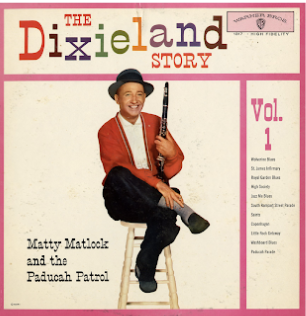
In the late 1950s, Warner Brothers commissioned Matlock for 5 LPs. The band would be known as Matty Matlock and the Paducah Patrol. They Made It Twice As Nice As Paradise And They Called It Dixieland (1958), The Dixieland Story Vol. 1 (1958), The Dixieland Story Vol. 2 (1959), Four Button Dixie (Recorded on November 18, 26 and 28, 1958, Hollywood, CA and released in 1959), and Gold Diggers in Dixieland (1960).15
The Dixieland Story, released in 1958, was a two-volume set that included Matlock on Clarinet, Eddie Miller on baritone sax, Shorty Sherock, John Best, on trumpets, Moe Schneider, Abe Lincoln on trombones, George Van Eps on guitar, Morty Corb on bass, Stan Wrightsman on piano, and Nick Fatool on drums. The albums feature the band blowing through numerous standards from the early 20th century like “Wolverine Blues,” “Saints,” “Tiger Rag,” and “Dippermouth Blues.” It also features “South Rampart Street Parade,” (a tune composed by Crosby bandmembers in 1935) and Matlock’s original “Paducah Parade,” a traditional sounding tune named for his hometown.16
In early 1959 the group's second Warner Brothers release, And They Called it Dixieland, was released as a follow-up album, pitched as a chronological sequel taking listeners through the 1930s. The Lou Busch produced album featured 12 songs. The Philadelphia Inquirer noted, “This type of music, long a favorite of jazz and pop fans alike, is spirited and bluesy. On ‘Runnin Wild,’ Matty presents this Dixie Standard in rousing style. ‘Lasy River,’ the clarinetist’ perennial favorite, recalls the real rhythm and blues style.” Also, in 1959 Matlock recorded with Godon Jenkin’s Orchestra backing Judy Garland for the recording of her album, The Letter.17
“I don't think there is a distinct ‘Dixieland,’ apart from other types of jazz... But please note that I mean true jazz. The important thing is a swing. If music has that, it’s jazz. If it doesn’t, I’ll let somebody else worry about it-it's not for me... You see, we play jazz. It doesn’t matter what – we are jazzmen, without limitations. This term ‘Dixieland,’ is something relatively new.” Matty Matlock
Following up on the success of, the Dixieland Story and They Called it Dixieland, Matty Matlock And The Paducah Patrol recorded the LP, Four-Button Dixie, in November 1958, in Hollywood, CA. Songs included, “In a Shanty in Old Shanty Town,” “When My Sugar Walks Down the Street,” “Some of These Days,” and “When Bhudda Smiles.” Players included Matlock on Clarinet, Eddie Miller on baritone sax, Shorty Sherock, John Best, Jack Coon on trumpets, Moe Schneider, Abe Lincoln on trombones, George Van Eps on guitar, Morty Corb on bass, Stan Wrightsman on piano, and Nick Fatool on drums. 18
In June of 1960 Matlock played saxophone for the album Bing and Satchmo recorded in Hollywood and released in October of that year. He continued recording with the Kings of Dixieland and can also be heard on the late 1960s live recordings at the University Club of Pasadena released at the Blue Angel Jazz Club.
Gold Diggers in Dixieland, was released in early 1961 and featured the same players as Four-Button Dixieland, minus Shorty Sherock. The album notes that many tunes that appeared on the album came from “Golddigger Motion Pictures,” and include takes on “We’re in the Money,” “Tip-toe Through the Tulips With Me,” and the “Sugar Daddy Strut.”19
Matlock toured Asia with Bob Crosby and the Bobcats in 1964 and in early 1965 surprised Floridians with a multiple month stint in Fort Lauderdale performing at the Beach Club Hotel with Billy Maxted Manhattan Jazz Club.20
In 1966, Matlock taught as a visiting lecturer for two weeks at Ohio State University. When asked about the event he noted, “You expose these kids to arranging music and you hope they get inspired enough to do it well, but it’s largely... inspiration, that is... something that has to be inside of them. I just picked it up. A little bit here, another technique there.” The same year he did a number of shows in New York with the Bobcats. 21
By the mid 1970’s Matty's arthritis began to make performing more difficult, but he didn't allow that to stop him. He spent lots of time playing golf, a sport that he loved dearly. In May of 1978 Los Angeles Mayor Tom Bradley proclaimed that June 18th would be Matty Matlock Day, with a full program and tribute to be held at the Pacifica Hotel, in Culver City, featuring Bob Crosby and former bandmates. Unfortunately, however, Matlock was in poor health at this time. On Friday, June 9, Bob Crosby and his Bobcats visited Matlock at Hacienda Convalescent Hospital in Van Nuys and performed for Matty (seated in a wheelchair). He had been admitted there in mid-May and reportedly enjoyed the concert by his old friends. Five days later, on June 14, 1978, Julian ‘Matty’ Matlock died from a heart condition and Parkinson’s disease. At the time he was survived by his wife Luara, two sons, two daughters and seven grandchildren. The tribute for him was still held on June 18. 22
Maida Ewing with the Simi Valley Star reported, “[I]Hit the Jazz Forum's first anniversary and "A Tribute to Matty Matlock" Sunday, and it was standing room only. The Forum also waived all admissions for the memorial attended by many of the greats. A lot of blues were played, and many tributes given to Mrs. Laura Matlock and her family. The King Zulus lead off the afternoon groups with "Blues On Parade" as opener. They were followed by Eddie Miller and Bobcats. Bob Crosby was in Boston and couldn't attend. Featured were Peanut Hucko on clarinet; Ab Lincoln on trombone; Dick Carey on trumpet; Nich Fatool, drums; Nappy Lamare guitar-banjo; Ray Coniff, trombone and Ray Leatherwood, bass. For a while, Dick Carey sat in on the piano. A highlight was Eddie Miller soloing on "Cry," a feast.”23
Matlock was buried in Forest Lawn Hollywood Hills on Monday, June 20, 1978. He left behind a legendary legacy of recorded memories. Arranger and composer Paul Weston summed it up, “If called upon I can make a case (as can my wife Jo Stafford) that Matty Matlock was the best clarinet player who ever lived – mush more versatile than some of his more famous peers.”24
Often thought of as a major continuer of Dixieland, Matlock once said, “I don't think there is a distinct ‘Dixieland,’ apart from other types of jazz... But please note that I mean true jazz. The important thing is a swing. If music has that, it’s jazz. If it doesn’t, I’ll let somebody else worry about it-it's not for me... You see, we play jazz. It doesn’t matter what – we are jazzmen, without limitations. This term ‘Dixieland,’ is something relatively new.” Matty made it swing and was a jazzman, without limitations.25
To learn more about Matlock and other Jackson Purchase musicians, please visit us in the Local and Family History Room at the McCracken County Public Library.
- Nathan Lynn
Footnotes:
1 National Archives at St. Louis; St. Louis, Missouri; Draft Registration Cards For Tennessee, 10/16/1940-03/31/1947; Record Group: Records of the Selective Service System, 147; Box: 188, Ancestry.com. U.S., World War II Draft Cards Young Men, 1940-1947 [database on-line]. Lehi, UT, USA: Ancestry.com Operations, Inc., 2011. August 21, 2025
Year: 1910; Census Place: Detroit Ward 12, Wayne, Michigan; Roll: T624_685; Page: 10b; Enumeration District: 0184; FHL microfilm: 1374698, Ancestry.com. 1910 United States Federal Census [database on-line]. Lehi, UT, USA: Ancestry.com Operations Inc, 2006.
Original data: Thirteenth Census of the United States, 1910 (NARA microfilm publication T624, 1,178 rolls). Records of the Bureau of the Census, Record Group 29. National Archives, Washington, D.C. For details on the contents of the film numbers, visit the following NARA web page: NARA. August 21, 2025
“A Tiny Peak Into Future Matty Maintains Jazz is Here To Stay.” Jordan, Phil, The Valley Times, September 15, 1964,Vol. 47 edition, sec. No. 217. https://www.newspapers.com/image/1188811526/.
“Music Club of Hume-Fogg Plan Silver Tea for April 13.” The Nashville Tennessean, North Hollywood, April 11, 1923, pg. 13. https://www.newspapers.com/image/580478737/?match=1&terms=%22Matty%20Matlock%22
Ancestry.com. U.S., World War I Draft Registration Cards, 1917-1918 [database on-line]. Provo, UT, USA: Ancestry.com Operations Inc, 2005. Original data:United States, Selective Service System. World War I Selective Service System Draft Registration Cards, 1917-1918. Washington, D.C.: National Archives and Records Administration. M1509, 4,582 rolls. Imaged from Family History Library microfilm.
Year: 1920; Census Place: Nashville Ward 25, Davidson, Tennessee; Roll: T625_1735; Page: 7B; Enumeration District: 99, Ancestry.com. 1920 United States Federal Census [database on-line]. Provo, UT, USA: Ancestry.com Operations, Inc., 2010. Images reproduced by FamilySearch. Original data:Fourteenth Census of the United States, 1920. (NARA microfilm publication T625, 2076 rolls). Records of the Bureau of the Census, Record Group 29. National Archives, Washington, D.C. For details on the contents of the film numbers, visit the following NARA web page: NARA. Note: Enumeration Districts 819-839 are on roll 323 (Chicago City), August 21, 2025
2 Chilton, John. Stomp off, let’s go!: The story of Bob Crosby’s Bob Cats & Big Band. London: Jazz Book Service, 1983.
3“Music Club of Hume-Fogg Plan Silver Tea for April 13.” The Nashville Tennessean, April 11, 1923, Vol. 14 edition, sec. No. 336. https://www.newspapers.com/image/178412937/
“Girl Orators Meet in Contest Tonight.” The Nashville Banner, May 9, 1924, Vol. 49 edition, sec. No. 30. https://www.newspapers.com/image/604850355/
“Arranger Is Man Behind the Band.” The Jackson Sun, December 3, 1939, Vol. 65 edition, No. 289. https://www.newspapers.com/image/281952037/
Jordan
4 Chilton
5 Chilton
6Chilton
“Julian C Matlock of Nashville.” The Paducah Sun, August 10, 1925, Vol. 28 edition, sec. No. 194. https://www.newspapers.com/image/1187772391/?match=1&terms=%22Julian%20C%20Matlock%22.
Carr, Ian; Fairweather, Digby; Priestley, Brian (2004). The Rough Guide to Jazz. Rough Guides. p. 516. ISBN 9781843532569. Retrieved 22 July 2016. Matty Matlock. “Matty Matlock.” Wikipedia, March 8, 2025. https://en.wikipedia.org/wiki/Matty_Matlock#cite_note-rgj-2.
“Matty Matlock Discography: Vinyl, Cds, & More | Discogs.” DiscCogs. Accessed August 26, 2025. https://www.discogs.com/artist/335665-Matty-Matlock.
Gill, Frank. “Bob Crosby Succeeds by His Own Efforts.” The Detroit Free Press, October 27, 1942, 112 edition, sec. 176. https://www.newspapers.com/image/98563406/?match=1&terms=%22Matty%20Matlock%22.
7 Chilton
8 “Stars Featured in Crosby Band.” Shamokin News-Dispatch, September 23, 1936, Vol. 4 edition, sec. No. 5. https://www.newspapers.com/image/66087957/.
Source Citation, Year: 1940; Census Place: Chicago, Cook, Illinois; Roll: m-t0627-01019; Page: 10B; Enumeration District: 103-3100. Source Information, Ancestry.com. 1940 United States Federal Census [database on-line]. Provo, UT, USA: Ancestry.com Operations, Inc., 2012.Original data: United States of America, Bureau of the Census. Sixteenth Census of the United States, 1940. Washington, D.C.: National Archives and Records Administration, 1940. T627, 4,643 rolls. Accessed August 25, 2025
“Matty Matlock Discography: Vinyl, Cds, & More | Discogs.” DiscCogs. Accessed August 26, 2025. https://www.discogs.com/artist/335665-Matty-Matlock.
Montgomery, R. Connor. “Matty Matlock.” Old Time Blues, December 3, 2016. http://oldtimeblues.net/tag/matty-matlock/.
Chilton
9 Chilton
“Arranger Is Man...”
10Chilton
National Archives at St. Louis; St. Louis, Missouri; Draft Registration Cards For Tennessee, 10/16/1940-03/31/1947; Record Group: Records of the Selective Service System, 147; Box: 188, Ancestry.com. U.S., World War II Draft Cards Young Men, 1940-1947 [database on-line]. Lehi, UT, USA: Ancestry.com Operations, Inc., 2011. August 21, 2025
1940
Fuzzy, Sclater, Jim. “From Camel Caravan Broadcast, 1940.” The clarinet bboard, May 10, 2024. http://test.woodwind.org/clarinet/BBoard/read.html?f=1&i=511475&t=511388&v=t.
“Bob Crosby Plays at Lakewood on Thursday, April 4.” The Record American, April 3, 1940, Year 68 No. 79. https://www.newspapers.com/image/925140915/
“Big Band clarinetist Matlock Dies,” Chicago Tribune, May 24, 1978, pg.10. https://www.newspapers.com/image/385954181/
11Chilton
”Matty Matlock Dies at 71; Memorial Tribute Slated,”
The Los Angeles Times, June 216, 1978, pg, 110. https://www.newspapers.com/image/384401293/.
12 Carlin, George. “Pollack Beating Drums After 21-Year Lapse.” Los Angeles Mirror, January 4, 1950. https://www.newspapers.com/image/693291379/?match=1&terms=%22Matty%20Matlock%22.
Bing Crosby with the Mellomen and Matty Matlock and his orchestra – with my shillelagh under my arm / st. patrick’s Day Parade | releases | discogs. Accessed September 24, 2025. https://www.discogs.com/master/411541-Bing-Crosby-With-The-Mellomen-And-Matty-Matlock-And-His-Orchestra-St-Patricks-Day-Parade-With-My-Shi.
Source Citation, National Archives at Washington, DC; Washington, D.C.; Seventeenth Census of the United States, 1950; Year: 1950; Census Place: Los Angeles, Los Angeles, California; Roll: 2149; Page: 18; Enumeration District: 66-186, Source Information, Ancestry.com. 1950 United States Federal Census [database on-line]. Lehi, UT, USA: Ancestry.com Operations, Inc., 2022., Original data: Department of Commerce. Bureau of the Census. 1913-1/1/1972. Population Schedules for the 1950 Census, 1950 - 1950. Washington, DC: National Archives at Washington, DC. Accessed August 25, 2025
Source Information, Ancestry.com. U.S., City Directories, 1822-1995 [database on-line]. Lehi, UT, USA: Ancestry.com Operations, Inc., 2011. Original data: Original sources vary according to directory. The title of the specific directory being viewed is listed at the top of the image viewer page. Check the directory title page image for full title and publication information. Accessed August 25, 2025.
“Louis Armstrong / Bing Crosby and Louis Armstrong – a Kiss to Build a Dream on / Gone Fishin’ (1952, Shellac) - Discogs.” www.Discogs.com. Accessed August 27, 2025. https://www.discogs.com/release/5424855-Louis-Armstrong-Bing-Crosby-And-Louis-Armstrong-A-Kiss-To-Build-A-Dream-On-Gone-Fishin-.
Bing Crosby and Andrews Sisters - South Rampart street parade / cool water. Accessed September 25, 2025. https://www.discogs.com/release/16485873-Bing-Crosby-And-Andrews-Sisters-South-Rampart-Street-Parade-Cool-Water.
13“Matty Matlock and His Jazz Band – Music from Jack Webb’s Mark ...” DiscCogs. Accessed September 23, 2025. https://www.discogs.com/Matty-Matlock-And-His-Jazz-Band-Music-From-Jack-Webbs-Mark-VII-Ltd-Production-Pete-Kellys-Blues/release/10198811.
Chilton
14 Matty Matlock and His Dixie-men. Dixieland. Matty Matlock and his dixie-men. Vinyl recording. Hollywood, CA, 1957.
Chilton
15 Chilton
16 “Matty Matlock and The Paducah Patrol – the Dixieland Story (1958, Vinyl) - Discogs.” DiscCogs. Accessed September 11, 2025. https://www.discogs.com/release/3685831-Matty-Matlock-And-The-Paducah-Patrol-The-Dixieland-Story.
Matty Matlock and the Paducah Patrol. The Dixieland Story. Vinyl recording. Hollywood, CA: Warner Bros, n.d.
17 “In the Groove.” The Bennington Evening Banner, January 24, 1958, https://www.newspapers.com/image/545770669/.
“Record Review.” Sheridan, Phil, The Philadelphia Inquirer, February 23, 1959, https://www.newspapers.com/image/177696831/?match=1&clipping_id=new
18 “Four-Button Dixie : Matty Matlock and The Paducah Patrol : Free Download, Borrow, and Streaming.” Internet Archive, January 1, 1970. https://archive.org/details/lp_four-button-dixie_matty-matlock-and-the-paducah-patrol.
Matty Matlock and the Paducah Patrol. Four-button dixie. Vinyl recording. Hollywood, CA: Warner Bros, 1958.
19 Matty Matlock and the Paducah Patrol. Matlock, Matty: Gold Diggers in dixieland. Vinyl recording. Hollywood, CA: Naxos Digital Services US Inc, n.d.
20 Chilton
21 “Jazz Ace is Prof Pro Term,” The Cincinnati Post, October 7, 1966. pg. 31. https://www.newspapers.com/image/1032329462/?match=1&terms=%22Matty%20Matlock%22
Chilton
22 Kelner, Dick “Gatsby Music Begat a gold record,” The Flint Journal, August 2, 1974, pg.51. https://www.newspapers.com/image/1104383295/?match=1&terms=%22Matty%20Matlock%22%20arthritis
“Matty Matlock Day Proclaimed,” Simi Valley Star, June 16, 1978, pg.57. https://www.newspapers.com/image/923878492/?match=1&terms=%22Matty%20Matlock%22
“Big Band clarinetist Matlock Dies,” Chicago Tribune, May 24, 1978, pg.10. https://www.newspapers.com/image/385954181/
23 Ewing, Maida, “Between the Lines: Bits and Pieces,” The Simi Valley, June 23, 1978, pg.4. https://www.newspapers.com/image/923901883/?match=1&terms=%22Matty%20Matlock%22
24“Big Band clarinetist Matlock Dies”
”Matty Matlock Dies at 71; Memorial Tribute Slated,”
Chilton
25 Jordan