
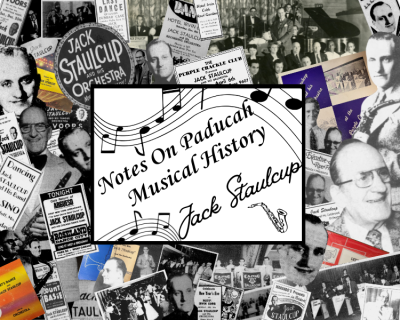
While best known as a Midwest big band leader, Jack Staulcup was also a musician, vocalist, recording artist, composer, businessman, and union advocate. Jack’s consistent touring out of Metropolis, IL, helped make him the king of Midwest big bands in mid-late 20th century America and took his orchestra from the Casa Loma in St. Louis to the Roseland in New York, and all points in between.
- Nathan Lynn, Local and Family History
Musician, Jack Staulcup was born November 17, 1907, in Martin, Weakley County, TN, to William Secratus “Crate” Staulcup and Carrie Baldridge Staulcup. William was a clerk for the N.C. and St. Louis Railway. When Jack was only two years old, his father was killed in a horrific railroad accident, between Nashville and Hickman, when two freights collided north of Nashville. Carrie remarried John Castleman, with whom she raised a family. The 1910 U.S. Census list Jack’s name as Carlos, and the 1920 census as Cavalier. He would use the name Jack for the rest of his life. The Castleman family moved to Gleason while Jack was in grade school. It was there that he learned to play saxophone and clarinet, studying under Charles Doran. He would later study under Burce Brummit, making trips to Memphis while in high school.1
When Jack was 16 the family moved to Gleason, just outside of Paris, TN. Around the same time, he and fellow students started a dance band, performing dances and social activities. Their school didn’t have a band director, so Jack and others hired a director to come to Gleason twice a week for instruction. The group took a gig at the Sunset Inn for $2 a night. While there, director Earl Pew, offered Staulcup his first job as a professional musician playing in the pit orchestra at the Dixie (Capitol) Theater in Paris, often playing for silent films. Jack attended Groves High School in the daytime and performed at night, while living in a hotel where he received his meals and $20 a week, enough to pay for room.2
Staulcup doubled on alto sax and clarinet and won a scholarship to study music at the University of Tennessee. Soon after graduating high school in 1926, he instead took a job with Frank Silvers/Silva, co-composer of, “Yes, We Have No Bananas,” making $50 a week. With Silver, Jack played first sax. They toured the American South and the eastern seaboard making stops in Chicago, New York, and Detroit that year. They also broadcast from WSM, WWNX, and WSMB, among other stations. It was during this time that Jack joined the musicians’ union for the first time in Chattanooga.3
“He offered me good money to play lead alto sax, and I said to heck with going to school,” Jack noted.4
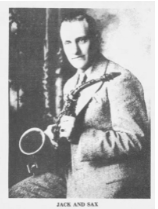
That summer, the group also made stops in Paducah, Mayfield, and Metropolis, and again in 1928. The band featured Hal Jordy, saxophone and director; H. Boisblanc, banjo and manager; Eddie Seybold, saxophone; Staulcup, saxophone; Sidney Spies, trumpet; Louis Chesson, piano; Frank Silva bass; Jimmie Cass, traps and featured dancer. It was Jacks first traveling gig but, he became ill with typhoid fever on the road and returned to Gleason.5
Soon after returning home in 1928, Jack attended a dance in Paris where the seven-piece Dixie Melody Boys were performing. The group needed a new sax player at the time. Jack was asked to set in for the night, after which he was hired on sax and vocals. He soon moved to Metropolis, IL where the band worked out of. Jack recalled that during this time 6 or 7 bigger commercial dance bands toured the Illinois, Kentucky, Missouri, Arkansas, Tennessee, Mississippi, and Indiana circuit. Jack would later work the same circuit with his own band. The Dixie Melody Boys broke up in 1931, due to numerous reasons including the Great Depression. Jack noted also, “They would stay sober on a little job that didn’t mean anything and then get drunk on a big one that did67
That year Jack temporarily moved to Memphis where he joined the local Musicians Union and worked sometime in the pit band at the Loew’s State Theater. He performed with Nat Evans at the Crystal Gardens; Sammy Lazeroy at the Silver Slipper; Bill Anderson and more. He soon returned to Metropolis within a year and temporarily reformed the Dixie Melody Boys as the Tennessee Serenaders until being fined $200 for doing non-union work. Jack then decided to organize his own professional band. 8
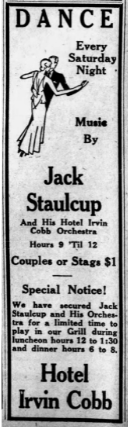
He had heard that the newly opened Hotel Irvin Cobb’s manager, Buddy Quinn, was looking to book a local band for luncheons and roof top dances. Quinn hired Staulcup for what would be an eight-week stretch. Starting in March of 1932, Jack and his Hotel Irvin Cobb Orchestra played their first engagement at the Cobb. At 24 years old, this was Jack's first show under his own leadership. Their first song played was, “Wish I Could Shimmy Like My Sister, Kate.” George Baker played cornet. Jack Staulcup and His Hotel Irvin Cobb Orchestra performed every Saturday night from 9PM – 12AM, along with Grill appearances from 12-1:30 PM and 6-8PM. This time at the Cobb set the group up for a long successful career.9
That same year they performed at Reelfoot Lake, Murphysboro, IL, and numerous dates in Perryville and St. Genevie, MO. They would go on to spend the first half of the decade working in Western Kentucky, Southeast Missouri, Northeast Arkansas, Northwest Tennessee, Southern Illinois, and Southern Indiana, like the route he had worked with the Dixie Melody Boys. They performed frequently on WPAD including Christmas morning specials. They were billed as Jack Staulcup and His Recording Orchestra (Band), later as Jack Staulcup and His “Band of the Southland,” the Jack Staulcup Orchestra, and more. They would in work Paducah their whole career when not on the road.10
Jack married Ethel Constance Moreland, a Metropolis native, in December 1930 in Springfield, IL. The couple had met at a dance Jack was performing at. Their first son, Jack Jr was born January 2, 1934 and went on to become a musician himself. He performed with his Father's orchestra over the years and went on to be a music director himself at Illinois State Prison for Boys. The couple’s second son Brent was born in January 1953 and would travel with the band for years, helping influence the groups’ song choices in the later years. His written memories provided numerous information for this piece .11
“We were no sensation, but the music was satisfactory, and the booking was a starting place,” said Staulcup Sr. While the band would later support 10 and 11 members, the early band was an 8 piece with three saxophones, two trumpets, piano, drums, and bass. The first brass section included Arthur Perkins, Raymond Craver, Dave Tyre, and Jack Sr. They traveled in a 1927 Lincoln which had “jump” seats between the front and main rear seats.12
The group managed to stay afloat through the Great Depression, but this was not without working hard and often accepting low pay. A huge Jan Garber fan, Jack intentionally studied the styles of bigger national acts like Garber, Wayne Kin, and Guy Lombardo, and learned that their saxophones used a wide fast vibrato. In 1933 while visiting a club in McKenzie, TN, Staulcup heard Murray State University student Boyd (Curley) Meyers, playing sax in this style. Jack promptly hired Meyers, who taught his rich vibrato style to the other sax players in the band.13
It was around this time that the band started performing Staulcup’s original number, “Nita,” which he had written in high school. The tune became the band's theme song, and the opening stanza was woven into orchestration of other songs in the set.14
The group worked the circuit for 3 or 4 years honing its sound. In June 1933, the orchestra played numerous roof top performances at the Irvin Cobb Hotel. For nine weeks in 1934. the group set up shop at the Kasey’s Club in Henderson, KY, performing nightly, and finished the year at the Irvin Cobb Hotel’s New Years Eve celebration (two days after Jack Jr. was born). The band kicked 1935 off with a three month stand at the Long Branch in Evansville, IN. They continued the same circuit with return appearances to Kasey's and, as always, the Hotel Irvin Cobb. They also made appearances at the Casa Loma in St. Louis, as the second band to ever perform there. They would continue to perform there for the rest of their careers. They also expanded and found audiences in Cincinnati and Knoxville.15
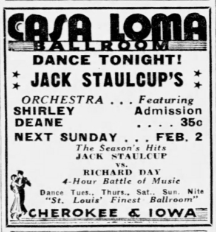
The latter part of the 1930s found the band working on their circuit and expanding. In 1936, an agent of McConkey Orchestra Corporation of Chicago picked them up and began bookings. They played the Casa Loma Ballroom in St. Louis for 16 weeks, some nights playing to 2,000 people. They then moved to the Castle Farm in Cincinnati. They began to appear on radio programs, and expanded into West Virginia and Knoxville, TN. They continued to play Paducah at the Cobb and other clubs in the area. In 1937, they did a multiple month stay at the Club Lake View, performing hits like, “Josephine,” and “You Can’t Stop Me From Dreaming.” They finished the year with a two-month stay at the Vanity Ballroom in Detroit, MI, where they shared the bill with a talented competition featuring a young Betty Hutton. The band consisted of numerous players during the late 1930s at the time including Bob Williams; Earl Harrison; Boyd (Curly) Myers, vocals; Russell “Fat” Phillips, trombone. In the spring of 1939 Joe Congiardo joined the group as a vocalist. The same year the band began to make daily radio appearances and did a three weeks stay at Bichon’s on Old Cairo Road in October.16
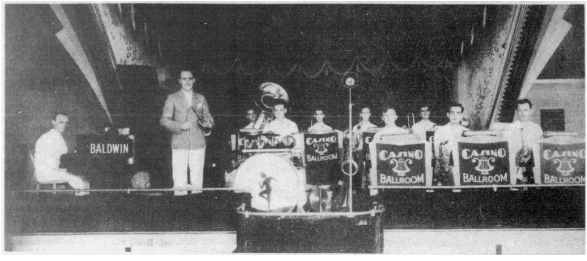
One of the most embarrassing events of Jack's career took place in 1939. Boyd Meyers drove the instrument truck to Tullahoma, TN, while the rest of the band arrived at their scheduled performance in Chattanooga. Due to Meyers mixing up the venues, the event had to be cancelled.17
The 1940s would see the band staying in the circuit that had built its fame but continuing to tour and expanding to spend time in Norh Mississippi. They performed as both a 10-piece and 11-piece orchestra. In January of 1942 another setback occurred when the orchestra lost all its equipment in a fire at Club Lido, in Texarkana, AR. The band was scheduled for a ten-week engagement and had been performing there for two of a six week stretch when the event occurred. They lost their musical library, stands, public address system, and horns. It was an estimated uninsured loss of $1,500. Also, around this time Meyers quit the band after 9 years and moved to California to work in electronics.18
Despite the losses the group was back on its feet quickly, continuing to build its following and by 1945 were riding a high in area popularity. That year Jack signed with the Associated Booking Corporation of America, one of the top 4 booking agents in the nation. However with the signing came some stipulations. Jack had to add another brass member to bring his band to an 11 piece. Their first show was the Plar-Mor in Kansas City. They expanded into Iowa and the quad cities, Nebraska, Florida, Kansas, Minnesota, and more. Between 1945 and 1948 the band performed at places like Buckeye Lake Resort in Columbus, OH; Lake Delavan Club in Wisconsin; Melody Mill Ballroom in Chicago; and Puritas Springs Park in Cleveland. 19
During this time the group appeared as Jack Staulcup and His Universal Recording Orchestra. In 1947, the band consisted of Russ Morgan, trombone; Oliver Hill, bass, electric guitar, vocals; James Tyrie, lead saxophone and arrangements; Mac McGranahan, trumpet; Wayne Emerson, piano; Staulcup, saxophone, clarinet, maestro and vocals. In 1949, the band headed into Universal Studios in Chicago to record the first of three popular songs. They recorded two sides: “Oh Moana,” and Jack’s original, “Nita.” Soon they also released the two sides: “I Need a Little Lovin,” and “How Many Times?” In July 1949 Staulcup was selling a two-side release of “I Can’t Give You Anything But Love,” and “Hard Luck Song.” The releases sold over 100,000 copies and provided some lifetime royalty money for Jack.20
In October 1949 the group performed as the band for the hit vocalist Ray Eberle at the Palace Theatre in McComb, MS.21
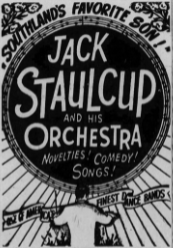
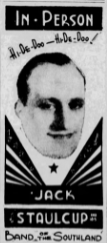
In the summer of 1950, the group spent time at the popular Palisades Amusement Park near New York City. The park saw up to 200,000 visitors a day. The band broadcast shows 4 nights a week for the Mutual Network, which carried 432 programs throughout the nation. Halfway through the summer they moved to Brighton Beach in Brooklyn to play outdoor concerts for the rest of the season.22
While Jack and Jack Jr. performed, Ethel worked in retail and sales. During this time the group traveled by way of a 25 passenger 1946 Pony Cruiser. With Metropolis as the home base, the early 50s saw the orchestra spending lots of time in Southern Illinois and expanding into New York, New Jersey, Ohio, and Louisianna. On April 6th, 1952, Jack Staulcup and His Orchestra appeared for the first noted time at the Purple Crackle Club in Cape Girardeau, MO. It would become an institution for the band .23
When Jack’s contract with the Associate Booking Corporation of America expired, the company offered an extension, but it was on the condition that he reduce his band size to a combo. Jack didn’t want to make that many cuts. Instead, he reduced to a 9 piece and started playing lead sax himself and returned to his old circuit. He booked as both a big band and as a 6 piece. Jack had seen the rise and slow decline of big bands, but he was positive that the market was still there.24
In 1953, the band traveled to South Carolina. That same year they also appeared on a double bill with Count Basie and his Orchestra at White City Park, in Herrin, Il. The group had been working the venue for years, but this was surely a highlight.25
In 1955, the group was jumping. It sometimes featured Paducah pianist Mrs. Leora Zarrick. They appeared alongside other local country acts like Fonzie Davis, in 1956 and 1957. It was also around this time one of Jack’s longest standing band members, Jim Windsor, joined the group. Jim would be a member of the band for decades to follow.26
With changing trends in the music world, the orchestra kept steady work but faced uncertainty as well. In 1957 Jack noted, “Look at our local (Paducah Musicians’ Local 200, AFL) today. We used to have a waiting list of young musicians who wanted a chance to work with a band. They were good kids, too. Kids who really know how to play their horns. Today there are practically no kids trying to get into the music business. We haven’t’ anything to offer them in the way of permanent employment and you can’t blame them for not wanting to practice hour after hour on their horns just to play part-time jobs.”27
“It’s the same way all over the country. The average age of your dance bands today is between 40 and 45 instead of 25 and 30 like it used to be. What’s going to happen when these oldtimers pull out? There won’t be enough competent musicians coming up to take their places and the big-name bands-those that still have enough work to hire full-time, professional musicians- won’t be able to turn to the road bands and those of less reputation for their personnel replacements because they won’t find any replacements there.”28
While Staulcup was still happy to change with the trends to entertain the people, he continued to worry regarding rock and roll, “I play it. I play anything the people like. But I can’t say that I like it much. It’s nothing but an old-time jazz beat that we used to hear in the lowest of honky-tonks around here. I’ve seen the time the people around here and practically anywhere else would laugh right out of the house an act like these rock-and-roll boys do. People just didn’t go for guitar pickers and hillbilly singers back then.”29
“Have you ever stopped to realize that music and entertainment have no rules, ethics, laws or controls governing their quality,” Jack said in a 1969 interview with Bill Powell. “Did you ever think manufacturers of guitar, electronic sound equipment, drums and moving picture equipment are reaping millions and millions from the rot some call music and entertainment?”30
Staulcup noted that the record industry’s attempt to seek out and promote cheap talent to keep product moving. He thought that record companies should only promote the best musicians. “I tell you the young people wouldn’t care anything about the bad music if they were exposed under proper, enjoyable circumstances to good music.31
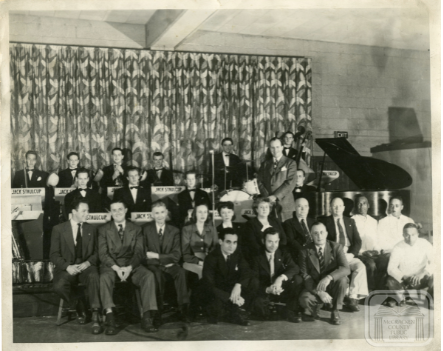
“Americans take only the best in everything else. Why should they take the worst in music.”32
By 1957 the band had played 30 states, 20 state capitals, and logged around 1,250,000 miles. At the time he valued his musical library to be around 670 songs to be worth around $2,000, with many of his arrangements written by Houston David of Jackson, MS. Jack was hopeful that the country was still interested in big band dance music. “The American people are getting hungry for good dance music again.”33
“Always play for the people. That has been my motto and I think it is a good one. If they want rock-and-roll, I have it in my library. If they want calypso, or boogie beat, I have that too.”34
It was around this time that Jack, seeing a decline in hotel rooms, nightclubs and dance halls, shifted his bookings toward one and two night stands in private clubs. Jack reported in 1959 that crowds at his shows were better than at any time since WWII. The band didn’t stop moving, with the early 60s proving to be as busy as ever.35
In 1960 they played the 4th annual Paducah Lions Club WPSD-TV Telethon. At the time they featured Ed White playing clarinet and Johnny Braham on trombone. Other highlights include July 4-8, 1961, when the orchestra performed supporting Connee Boswell and Snooky Lanson in Memphis. In 1962 Jack reported the band was still playing 2 to 5 nights per week and that younger generations were still storming the dance floor for fox trot numbers.36
In the early 1960s, the double side 33 1/3 issue, Request Time with Jack Staulcup and his Orchestra was released. At the time the band consisted of Jack Staulcup, band leader, first saxophone, vocals; Ron Talent, first trumpet; Tom Berry, second trumpet; Ron Coward, trombone; Home Pruitte, piano and vocals; Ron McKeel, drums; Curtis Mills, bass, Jim Windsor, third saxophone; and Ed White, second saxophone. Tracks include a “Medley (Oklahoma, Surrey with a Fringe on Top, People Will Say We’re in Love, Who You Why, Blue Room, I wan to be Happy, Five Me a Hune Night, Paper Moon, Moonlight and Roses, My Happiness),” “Waltz Medley (Diane, Alice Blue Gown, My Gal Sal, Lasses Trombone),” “Nita,” “Smack Dab in the Middle,” “June Night,” “I need Lovin,” “Josephine,” and “Oh Monah.” The album was recorded by Century Custom Recording Service, Thomas F. Morris, Franchised Assoc. 3029 Oregon St. Paducah, KY.37
Jack was a dedicated Union man. He served numerous terms as the head of the Paducah Local No. 200. 1963 he could be found lobbying for union causes in numerous papers and was elected the Union president in 1965. 38
The mid-1960s saw the band playing the circuit and leaning on their familiarity. In 1965 and 1966, Staulcup and his band made numerous appearances on WPSD-TV Accent. That year the band included Lowell Stearsman on sax and clarinet and R.H. Pruitte on piano and arrangement.39
The band still seemed to find its home in Paducah. Over the years they would play nearly every imaginable club including the Cobb, Voors, Cabana, Executive Inn, and more. As busy as the band was with their performances, they still found time for recording with Paducah’s Thomas Morris and Century Custom Recording Services. They would make numerous albums with Morris.
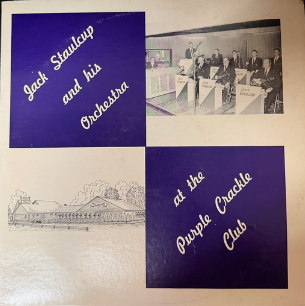
One of Jack’s most notorious record releases was Jack Staulcup and his Orchestra at the Purple Crackle. In the early 1950s, the band started performing at the Purple Crackle, one of the most popular clubs in the Midwest. It was located in Southern Illinois, East Cape Girardeau on Highway 146 near the Mississippi River. It served both American and Chinese cuisine and catered to fans of dance orchestras. The album features Jack Staulcup, first saxophone, vocalist, band leader; Lowell Stearsman, second saxophone; Gary Moore, third saxophone; Eddie White, baritone saxophone; Charles James, first trumpet; Irvin Gilson, second trumpet; Lee Sommers, trombone; Jim Latimer, drums; Curtis Mills, bass; Joe Jackson, piano. Tracks include, “I Love Because You're You,” “I Left My Heart In San Francisco,” “Skirts, “(Medley) Days Of Wine And Roses - Moonlight Becomes You,” “I Double Dare You,” “Walk Right In (Twist),” “Ballin' The Jack,” “Alley Cat,” “I Wish I Could Shimmy Like My Sister Kate,” “Cecelia,” “(Waltz Medley) Honeymoon Waltz - In A Little Spanish Town - Dreamy Melody,” and “The Green Door (Twist).” The album is a classic time piece into Midwest dance bands. The band shines and Staulcup’s vocals set a tone that highlights a moment. Through the end of 1970’s the band continued to perform at the notorious Purple Crackle club in East Cape Girardeau. The band performed at the Purple Crackle for 17 years, doing years of Sunday shows. 40
While Jack continued to try to lean into a couple of rock and roll songs, performing popular numbers, he also thought much of the music was not of his caliber, noting that the modern “jungle music” stimulated obscenities and juvenile delinquency. He again blamed recording companies for being cheap and recording anything marketable. He published a brochure titled, “Today’s Teen-Agers and Dance Music.” “They certainly can’t dance to it. All they can do to the loud jungle beat is to move their bodies in an obscene motion. It has become a national disgrace to our society that most teenagers today cannot dance gracefully and decently as they did for years and years prior to 1953,” said Staulcup. He began to speak out for musical censorship in the late 1960s.41
Despite his feelings toward the genre, his younger sons urged him to perform more contemporary rock-oriented tunes, to appeal to school dances and younger listeners. He acquired arrangements and the group began to play more modern tunes, including ballads from the Beatles, Jimmy Webb, and Burt Bacharach. They even covered Three Dog Night's, Joy to The World, and Jim Croce's, Bad, Bad, LeRoy Brown.42
The groups’ double sided, Meanwhile Back on the Bandstand (BBS103), was released around 1968. It was distributed and promoted by RCI Records (RCI Music Promotion), engineered by Thomas Morris, and Produced by Francis Fech. Songs included: “Are You Afraid I'd Make Your Cry?,” “It's All Very Funny,” “My Love Is,” “Untitled Medley (If You Remember, I'll Never Forget I Love You, If It Hadn't Been For You),” “This Is The Last Time (I'll Cry Over You),” “Release Me,” “Please Don't Come Cryin' To Me,” “Tears Are Easier Than Laughter,” “Untitled Medley (Go Ahead And Lie, Moment Of Truth),” “(My Tears Are) Thoughts Of You,” “(I'm Cryin') Cryin' Again.”43
Jack’s son, Brent Staulcup, noted that, “Arguably, the 1960s was the most successful decade for the orchestra. Even though the genre of music, had largely fallen out of favor in popular culture. Key to this success, is that the band held a virtual monopoly on big band music between St. Louis and Nashville during this timeframe.”44
“Jack, with remarkable pois and good sense, narrated a performance by his band covering musical taste of the dancing crowd from before the Big Apple craze through part of the Beatle nightmare,” noted Bill Powell, in a 1965 review in the Paducah Sun.45
In 1969, the band was still averaging around 50,000 miles a year, and by 1971 the group had found a built-in audience on the circuit that they had worked for years. The first part of the decade the band spent playing the circuit but focusing on a smaller radius. They continued with their Casa Loma bookings and released a new double side album. Let’s Dance with Jack Staulcup and his Orchestra was recorded around 1972. Players included Jack Staulcup, saxophone, vocals, band leader; Bill Robins, saxophone; Jim Windsor, saxophone; Irvin Gilson, trumpet; Charlie James, trumpet; Fleetis Hannah, trombone; Curtis Mills, bass, John Oldham, piano; Jim Pettit, drums. Tracks included “Mack the Knife,” “For the Good Times,” “Sweet Georgia Brown,” “Somewhere My Love,” “Proud Mary,” “Easy Lovin’,” “Snow Bird,” “Help Me Make It Through The Night,” “St. James Infirmary Blues,” “Spanish Eyes,” “Kansas City,” and “Waltz Melody; Fascination and Around the World I Eighty Days.”46
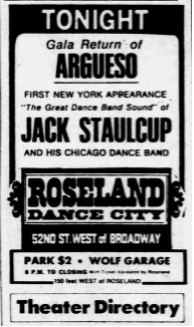
In 1972 Jack took the orchestra to New York City to the famous Roseland Dance City, 239 W. 52nd St. for a 4-week stint starting in late July and again in May/June 1973. This was no doubt a dream booking for Jack at the time, but according to his son, he found the area “crime infested and had his wallet stolen during his time there.” Unfortunately, during the end of the 1973 run, he began to feel sick. Assumedly working under the premise of, “the show must go on,” Jack decided to wait until he got home to Paducah to seek a doctor. Upon arriving at the airport, he told his wife to take him immediately to the hospital. Jack had suffered a heart attack and was in the hospital for several weeks. After the incident he tried to relinquish business duties to others like James Windsor and instead focus his time on performing and his health. His son Brent noted that, “Staulcup returned to the band, but was limited to a few vocals, and mainly served as a front man who often mingled among his fans during the performance.” 47
In May 1975 Jack was presented with a Duke of Paducah Award for his 43 years of orchestra leadership. In the same year, the American Federation of Musicians honored Jack with a life membership gold card for his years of Union service.48
One music critic marveled, “The Staulcup band has never played music that was too far to the right (over the public’s head) or too far to the left. Its music has always been down the middle of the road that any ear could grasp and very danceable.”49
In the early 1970’s, Jack continued his crusade against rock and roll. In an address to the Fulton Rotarians in 1972 the Fulton Leader noted, “Jack’s main point was to prove that good music produces better musicians plus a better society in which to live, while bac music creates the very problems we face today – drug abuse, crime, atheism, the tremendous rise in: divorce, arrests, venereal disease, illegitimate births, and suicides.” 50
In 1975 Jack reported having dreams about dying and being buried with a rock group and having to listen to the for eternity, noting, “Jack has always believed there is more to music than twanging guitars, loud-blaring amps and would-be singers.”51
He noted that when he joined the union, he had to take a test to be able to read music as well as play by ear. “Now if you can hit a couple of good chords on at guitar-you're in,” said Jack. He also credited Lawerence Welk with a renewed interest in big band music.52
The late 1970s saw no sign of letting up for the band. “...we’ve traveled two and a half million miles. We’ve played almost every place where they had ballroom dancing between Denver and New York City at some time or another.”53
By 1979 he had been president of the union for 13 years. He began the year performing at the Illinois Governors inaugural ball for James Thompson (having appeared in 1975 at his first inauguration as well) and closed out the year with a cover feature in the nationally circulated magazine, The Big Bands. 54
The 1980’s saw the band as busy as ever and performing the same circuit they had built in the 1930s. While none of Jack’s original band members remained performing in the band, Jack said, “I run my band like a football team; you’ve got to bring in new talent.”55
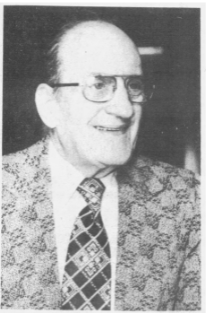
Jack had numerous band members over the years. In 1975 his members ranged in age from 24 to 50, with 5 of his members being with him for over 12 years. For decades he provided jobs for musicians who went on to perform in other bands. 1932 band member, Conn Lynn Humphreys, who was a Murray native, went on to become the musical director of the Columbia Broadcasting Company. Russell Phillips, went on to be employed in Louis Armstrongs band. Joe Hambrick, trombone player, played with the great Jan Garber band. Some other of Jacks band members over the years included Charles Demaree; Phil Greenwell, drums; Harry Absher trumpet; Phillp Valenta sax; Glady’s Knight Estes-Kuhn and Lee Loveall, vocals; Dr. LaVerne E. Livingston drums; Norman Mullinix and Edward King Clayman. Edwin Lacy, saxophone, January, 1957 through August of 1959. Norris Lacy, saxophone, circa 1959 through mid-1962.56
While Jack was outspoken in years past about rock and roll, it was noted he and the band did find some interest in performing selected popular tunes. Jack described being booked at a high school in November of 1980 where students had studied ballroom dancing.
“We started off with a couple of disco numbers like, ‘Theme from Rocky’ and ‘Stayin’ Alive’ and I looked around and there were 300 kids just sitting there. The superintendent came by and said, ‘How about playing some waltzes?’ I said, ‘Waltzes?’ We started playing them and I never saw more graceful dancers.”57
Reflecting on his career in 1982, Jack said, “When I get on that bandstand I’m just as happy as I was when I was 24 years old.” Staulcup noted, “I was a pretty good sax player until I became a leader and now I have so much on my mind. I don’t care about an instrument now. I just want to make sure the people are entertained.58
When asked about retirement, he said, “I’ve never thought about doing anything else. When people see their doctor, they are sick; when they see a lawyer, they’re in trouble. When they come to me, they’re enjoying life and I feel I’ve done something constructive if I can contribute to that.”59
Jack expressed that while the trips state to state with few days off got to him, “...I'll stand as long as God lets me”60
In June of 1982 the band notched another highlight in their career, performing in Knoxville, TN, during the World’s Fair. At the time the orchestra was mainly made up of Cape Girardeau residents Jim Windsor; Beverly Reese, piano; Joe Weber, drums; Terry Gockel and Bob Bartley, trumpets; Brad Smith, trombone; Randal Smith and Bill French, saxophones.61
The band continued to play steady, including their staple St. Patrick’s Day, Christmas balls and NYE events. By 1984 the Jack Staulcup Orchestra was celebrating 52 years and in Jack’s words, “the only dance band going for 52 years where the leader who organized the band is still around."62
Jack once said without music he would have been the “saddest of nations.” “I might not do it exactly the same way, but I’d do it all over again.”63
The band started 1985 out busy as ever and riding a somewhat resurgence in big band music. On May 5th, the band was scheduled to play in Herrin, IL. On May 9th the Paducah Sun reported that Jack was in the hospital. While still at the top of the Midwest big band leaders, Jack died on May 10, 1985 at the age of 77, at Western Baptist Hospital, after battling pancreatic cancer. Memorials appeared in newspapers across the Midwest, for the big band leader people had loved hearing for over half a decade.64
He was survived by his wife, Ethel, his two sons Jack and Brent, four grandchildren, three great-grandchildren, a half-brother, and a half-sister. His funeral was held at Akins-Farmer Funeral Home, and he was buried in Memorial Gardens Cemetery in Metropolis, IL.65
After Jack’s passing, Ethel kept the business running for several years. Longtime sideman, Bill French, took over as band leader. The market for big band music finally dwindled, and many of the orchestras’ members became retired weekend hobby players. In 1989, after some 57 years, the Jack Staulcup Orchestra ended.66
For more information on Jack Staulcup and other area musicians, visit the McCracken County Public Library Local and Family History Department.
Footnotes:
1 Sanderson, Bob. “Man with a Band,” The Paducah Sun, Mar 24, 1957, Vol. 80, No. 71edition. https://www.newspapers.com/image-view/428960664/?match=1&clipping_id=new
Powell, Bill, “From Bill Powell’s...,” The Paducah Sun, Apr 5, 1962, Vol. 85, No. 81 edition. https://www.newspapers.com/image-view/429122916/?match=1&terms=%22Jack%20Staulcup%22
“On Channel 6...,” The Paducah Sun, Mar 22, 1969, Vol. 58, No. 290 edition.
https://www.newspapers.com/image-view/429087983/?match=1&terms=%22Jack%20Staulcup%22
Anderson, Bettye. “Younger groups groove...,” The Jackson Sun, Apr 13, 1984, https://www.newspapers.com/image-view/283566459/
Year: 1920; Census Place: Civil District 23, Weakley, Tennessee; Roll: T625_1771; Page: 9B; Enumeration District: 157
Ancestry.com. 1920 United States Federal Census [database on-line]. Provo, UT, USA: Ancestry.com Operations, Inc., 2010. Images reproduced by FamilySearch.
Original data: Fourteenth Census of the United States, 1920. (NARA microfilm publication T625, 2076 rolls). Records of the Bureau of the Census, Record Group 29. National Archives, Washington, D.C. For details on the contents of the film numbers, visit the following NARA web page: NARA. Note: Enumeration Districts 819-839 are on roll 323 (Chicago City).
Year: 1910; Census Place: Martin, Weakley, Tennessee; Roll: T624_1525; Page: 6a; Enumeration District: 0135; FHL microfilm: 1375538
Ancestry.com. 1910 United States Federal Census [database on-line]. Lehi, UT, USA: Ancestry.com Operations Inc, 2006.
Original data: Thirteenth Census of the United States, 1910 (NARA microfilm publication T624, 1,178 rolls). Records of the Bureau of the Census, Record Group 29. National Archives, Washington, D.C. For details on the contents of the film numbers, visit the following NARA web page: NARA.
2Lowe, Ophellla. “St. Patrick’s Day...,” West Kentucky News, Mar 17, 1976, Vol. 8, No. 51edition. https://www.newspapers.com/image-view/1187719761/?match=1&clipping_id=new
Kennedy, Preston. “Band leader Jack...,” The Paducah Sun, Mar 18, 1976, Vol. 98, No. 67 edition. https://www.newspapers.com/image-view/429761303/?match=1&terms=%22Jack%20Staulcup%22
Sanderson
Powell
3 Kennedy, Preston. “Band leader Jack...,” The Paducah Sun, Mar 18, 1976, Vol. 98, No. 67 edition. https://www.newspapers.com/image-view/429761303/?match=1&terms=%22Jack%20Staulcup%22
Sanderson
Powell
Lowe
4Anderson
5 Johnson, Robert. “Words and Music...,” The Memphis Press-Scimitar, Sep 9, 1947, Vol. 67, No. 271 edition. https://www.newspapers.com/image/798284508/?match=1&clipping_id=new
Kennedy
“Style Show, New...,” The Johnson City Staff-News, Oct 4, 1927, Vol. 18, No. 145 edition. https://www.newspapers.com/image/585442832/?match=1&clipping_id=new
“Invitations Issues to...,” The Paducah Sun, Mar 22, 1928, Vol. 31, No. 69 edition. https://www.newspapers.com/image/585442832/?match=1&clipping_id=new
Sanderson
Lowe
6 Sanderson
7Sanderson
Kennedy
Powell
8“Jack Staulcup’s Orchestra...,” The Paducah Sun, Jan 10, 1947, Vol. 70, No. 8 edition. https://www.newspapers.com/image/1190489243/?match=1&clipping_id=new
Sanderson
Johnson, Robert. “Words and Music...,” The Memphis Press-Scimitar, Sep 9, 1947, Vol. 67, No. 271 edition. https://www.newspapers.com/image/798284508/?match=1&clipping_id=new
“Style Show, New...,” The Johnson City Staff-News, Oct 4, 1927, Vol. 18, No. 145 edition. https://www.newspapers.com/image/585442832/?match=1&clipping_id=new
“Invitations Issies to...,” The Paducah Sun, Mar 22, 1928, Vol. 31, No. 69 edition. https://www.newspapers.com/image/585442832/?match=1&clipping_id=new
Lowe
9 Sanderson, Bob. “Man with a Band,” The Paducah Sun, Mar 24, 1957, Vol. 80, No. 71edition. https://www.newspapers.com/image-view/428960664/?match=1&clipping_id=new
“Rudy had it...,” The Paducah Sun, Jan 7, 1979. https://www.newspapers.com/image-view/426344602/?match=1&terms=%22Jack%20Staulcup%22
Sanderson
“Dance,” The Paducah Sun, Mar 11, 1932, Vol. 55, No. 91 edition. https://www.newspapers.com/image/1185818266/?match=1&clipping_id=new
“Grand Opening Dance...,” The Paducah Sun, May 10, 1932, Vol. 55, No. 142 edition. https://www.newspapers.com/image/1185814930/?match=1&clipping_id=new
10 “Big Dance...,” Ste. Genevieve Herald, Jun 4, 1932, Vol. 51, No. 12 edition. https://www.newspapers.com/image/1028204802/?match=1
“Big Masquerade Ball,” Perry County Sun, Oct 27, 1932, Vol. 53, No. 34 edition. https://www.newspapers.com/image/687698040/?match=1&terms=%22Jack%20Staulcup%22%20
“Dance on Cobb...,” The Paducah Sun, Jun 23, 1933, Vol. 56, No. 149 edition. https://www.newspapers.com/image/1185820413/?match=1&terms=%22Jack%20Staulcup%22%20
Kennedy
“Dance on at Walnut...,” Paragould Soliphone, Jun 29, 1933, Vol. 42, No. 72 edition. https://www.newspapers.com/image/1101873502/?match=1&terms=%22Jack%20Staulcup%22%20
“Noted Band to...,” The Vincennes Sun-Commercial, Jul 11, 1933, Vol. 69, No. 123 edition. https://www.newspapers.com/search/results/?date-end=2000&date-start=1905&keyword=%22Jack+Staulcup%22&sort=paper-date-asc
“Anne Duckworth to...,” The Memphis Commercial Appeal, Sep 24, 1933, Vol. 127, No. 86 edition. https://www.newspapers.com/image/769215406/?match=1&terms=%22Jack%20Staulcup%22%20
“Jack Staulcup and...,” Perry County Republican, Mar 28, 1934, Vol. 45, No. 32 edition. https://www.newspapers.com/image/688108258/?match=1&clipping_id=new
“The Casino Dancing..,” The Memphis Commercial Appeal, May 31, 1934, Vol. 128, No.151 edition. https://www.newspapers.com/image/769214829/?match=1&terms=%22Jack%20Staulcup%22
“Staulcup’s Band to ..,” Henderson Morning Gleaner, Oct 21, 1934, Vol. 46, No.154 edition. https://www.newspapers.com/image/1083234431/?match=1&clipping_id=new
“Celebrate New Year’s...,” The Paducah Sun, Dec 30, 1934, Vol. 57, No. 311 edition. https://www.newspapers.com/image/1185829247/?match=1&clipping_id=new
“Change Orchestra,” The Evansville Press, Mar 31, 1935, Vol. 39, No. 274 edition. https://www.newspapers.com/image/763070220/?match=1&terms=%22Jack%20Staulcup%22
“Attention! St. Louis,” The St. Louis Globe-Democrat, Oct 27, 1935, Vol. 61, No. 161 edition. https://www.newspapers.com/image/573363189/?match=1&terms=%22Jack%20Staulcup%22
“To Play at Dance...,” The Daily American Republic, Apr 9, 1936, Vol. 27, No. 64 edition. https://www.newspapers.com/image/937611776/?match=1&clipping_id=new
“More About Gwen...,” The Knoxville News-Sentinel, Apr 19, 1936, No. 16292 edition. https://www.newspapers.com/image/937611776/?match=1&clipping_id=new
11 Powell
Kennedy
Goddard, Bob. “Jack Staulcup Maestro,” The Fulton County News, Aug 2, 1971, Vol. 39, No. 31 edition. https://www.newspapers.com/image-view/1041751367/?match=1&clipping_id=new
Ancestry.com. U.S., Social Security Applications and Claims Index, 1936-2007 [database on-line]. Provo, UT, USA: Ancestry.com Operations, Inc., 2015.
Original data: Social Security Applications and Claims, 1936-2007.
Staulcup, Brent. “Jack Staulcup Orchestra.” Wikipedia. Wikimedia Foundation, August 14, 2025. https://en.wikipedia.org/wiki/Jack_Staulcup_Orchestra.
12 Sanderson
13 Sanderson
Kennedy
14 Sanderson
15 Sanderson
Goddard
“Dance on Cobb...,” The Paducah Sun, Jun 23, 1933, Vol. 56, No. 149 edition. https://www.newspapers.com/image/1185820413/?match=1&terms=%22Jack%20Staulcup%22%20
“Dance on at Walnut...,” Paragould Soliphone, Jun 29, 1933, Vol. 42, No. 72 edition. https://www.newspapers.com/image/1101873502/?match=1&terms=%22Jack%20Staulcup%22%20
“Noted Band to...,” The Vincennes Sun-Commercial, Jul 11, 1933, Vol. 69, No. 123 edition. https://www.newspapers.com/search/results/?date-end=2000&date-start=1905&keyword=%22Jack+Staulcup%22&sort=paper-date-asc
“Anne Duckworth to...,” The Memphis Commercial Appeal, Sep 24, 1933, Vol. 127, No. 86 edition. https://www.newspapers.com/image/769215406/?match=1&terms=%22Jack%20Staulcup%22%20
“Jack Staulcup and...,” Perry County Republican, Mar 28, 1934, Vol. 45, No. 32 edition. https://www.newspapers.com/image/688108258/?match=1&clipping_id=new
“The Casino Dancing..,” The Memphis Commercial Appeal, May 31, 1934, Vol. 128, No.151 edition. https://www.newspapers.com/image/769214829/?match=1&terms=%22Jack%20Staulcup%22
“Staulcup’s Band to ..,” Henderson Morning Gleaner, Oct 21, 1934, Vol. 46, No.154 edition. https://www.newspapers.com/image/1083234431/?match=1&clipping_id=new
“Celebrate New Year’s...,” The Paducah Sun, Dec 30, 1934, Vol. 57, No. 311 edition. https://www.newspapers.com/image/1185829247/?match=1&clipping_id=new
“Change Orchestra,” The Evansville Press, Mar 31, 1935, Vol. 39, No. 274 edition. https://www.newspapers.com/image/763070220/?match=1&terms=%22Jack%20Staulcup%22
“Attention! St. Louis,” The St. Louis Globe-Democrat, Oct 27, 1935, Vol. 61, No. 161 edition. https://www.newspapers.com/image/573363189/?match=1&terms=%22Jack%20Staulcup%22
“To Play at Dance...,” The Daily American Republic, Apr 9, 1936, Vol. 27, No. 64 edition. https://www.newspapers.com/image/937611776/?match=1&clipping_id=new
“More About Gwen...,” The Knoxville News-Sentinel, Apr 19, 1936, No. 16292 edition. https://www.newspapers.com/image/937611776/?match=1&clipping_id=new
16Sanderson
“From Bob Sanderson’s,” The Paducah Sun, Ap 4, 1957, Vol. 80, No. 80 edition. https://www.newspapers.com/image-view/428988855/?match=1&terms=%22Jack%20Staulcup%22
“Daily Radio Programs,” The Paducah Sun, July 27, 1937, Vol. 55, No. 177 edition. https://www.newspapers.com/image/1185902038/?match=1&terms=%22Jack%20Staulcup%22
“Jack Staulcup and His Orchestra,” The Perry Republican, Feb 3, 1938, Vol. 49, No. 25 edition. https://www.newspapers.com/image/688105369/?match=1&clipping_id=new
“Club Lake View,” The Paducah Sun, July 22, 1937, Vol. 55, No. 173 edition. https://www.newspapers.com/image/1185901485/?match=1&clipping_id=new
“Jack Staulcup’s Orchestra,,” The Paducah Sun, July 22, 1937, Vol. 55, No. 173 edition. https://www.newspapers.com/image/1185901485/?match=1&clipping_id=new
“O’Neil’s,” The Bloomington Pantagraph, Mar 11, 1939, Vol. 93, No. 70 edition. https://www.newspapers.com/image/69374488/?match=1
“Joe Congiardo Joins...,” The Murphysboro Daily Independent, Mar 14, 1939. https://www.newspapers.com/image/10443783/?match=1&clipping_id=new
“Bichon’s Inn,” The Paducah Sun, Oct 15, 1939, Vol. 5, No. 246 edition. https://www.newspapers.com/image/1190473356/?match=1&clipping_id=new
“Speaking of Bands,” The Evansville Press, Dec 24, 1942, Vol. 37, No. 152 edition. https://www.newspapers.com/image/763342728/?match=1&terms=%22Jack%20Staulcup%22
17 Sanderson
“For Your Entertainment,” The Greenwood Commonwealth, Sep 26, 1940, Vol. 25, No. 22 edition., . https://www.newspapers.com/image/237701214/?match=1&terms=%22Jack%20Staulcup%22
18Sanderson
“Jack Staulcup Loses...,” The Paducah Sun, Jan 30, 1942, Vol. 55, No. 26 edition. . https://www.newspapers.com/image/1190845110/?match=1&clipping_id=new
19Sanderson
“Jack Staulcup s...,” The Cedar Rapids Gazette, Jun 11, 1945, Vol. 63, No. 153 edition. . https://www.newspapers.com/image/548638201/?match=1&terms=%22Jack%20Staulcup%22
“Staulcup Band at...,” The Cedar Rapids Gazette, Sep 26, 1947, Vol. 65, No. 260 edition. . https://www.newspapers.com/image/550858871/?match=1&clipping_id=new
20 Sanderson
Johnson
“Jack Staulcup’s Orchestra...,” The Paducah Sun, Jan 10, 1947, Vol. 70, No. 8 edition. . https://www.newspapers.com/image/1190489243/?match=1&clipping_id=new
“Sikeston Bargain Days,” The Sikeston Daily Standard, Jul 27, 1949, Vol. 37, No. 237 edition. . https://www.newspapers.com/image/89354993/?match=1&terms=%22Jack%20Staulcup%22
21 “The Veterans of...,” The McComb Enterprise-Journal, Oct 7, 1949, Vol. 60, No. 42 edition. . https://www.newspapers.com/image/252054973/
23 Source Citation
National Archives at Washington, DC; Washington, D.C.; Seventeenth Census of the United States, 1950; Year: 1950; Census Place: Metropolis, Massac, Illinois; Roll: 4618; Page: 72; Enumeration District: 64-11
Source Information
Ancestry.com. 1950 United States Federal Census [database on-line]. Lehi, UT, USA: Ancestry.com Operations, Inc., 2022.
Original data: Department of Commerce. Bureau of the Census. 1913-1/1/1972. Population Schedules for the 1950 Census, 1950 - 1950. Washington, DC: National Archives at Washington, DC.
Population Schedules for the 1950 Census, 1950 - 1950. NAID: 43290879. Records of the Bureau of the Census, 1790 - 2007, Record Group 29. National Archives at Washington, DC., Washington, DC.
“Bus - 1946...,” The St Louis Globe-Democrat, Jul 24, 1952, Vol. 78, No. 43 edition. . https://www.newspapers.com/image/89354993/?match=1&terms=%22Jack%20Staulcup%22
“Jack Staulcup and...,” The News, Patterson, NJ, Aug 5, 1950, Vol. 60, No. 191 edition. https://www.newspapers.com/image/526757419/?match=1&terms=%22Jack%20Staulcup%22
“Staulcup Orchestra to...,” The Paducah Sun, Aug 5, 1950, Vol. 73, No. 186 edition. https://www.newspapers.com/image/428426069/?match=1&terms=%22Jack%20Staulcup%22
“Follow the Crowd to...,” The Akron Beacon Journal, Jul 31, 1950, Vol. 73, No. 186 edition. https://www.newspapers.com/image/428426069/?match=1&terms=%22Jack%20Staulcup%22
“Now Playing...,” The Crowley Post-Signal, May 26, 1950, Vol. 51, No. 224 edition. https://www.newspapers.com/image/470018052/?match=1&terms=%22Jack%20Staulcup%22
“The Purple Crackle” The Southeast Missourian, Apr 3, 1952, Vol. 48, No. 155 edition. . https://www.newspapers.com/image/1001376176/?match=1&clipping_id=new
24 Sanderson
25 “Dance Under the...” The Charolette Observer, Sep 2, 1953, Vol. 85, No. 146 edition. . https://www.newspapers.com/image/618819336/?match=1&terms=%22Jack%20Staulcup%22
“White City Park...” The Southern Illinoisian, May 29, 1953, Vol. 61, No. 127 edition. https://www.newspapers.com/image/78016744/?match=1
26 “Seats Still Available...,” The Paducah Sun, Apr 13, 1955, Vol. 78, No. 87 edition. https://www.newspapers.com/image-view/428663803/?match=1&terms=%22Jack%20Staulcup%22
“3 Candidates...,” The Paducah Sun, Jul 31, 1956, Vol. 79, No. 183 edition. https://www.newspapers.com/image-view/1186258721/
“Cooperation Urged...,” The Mayfield Messenger, Aug 5, 1957, Vol. 58, No. 182 edition. https://www.newspapers.com/image-view/1016602162/
Rains, Donna. “New generation discovers...,” The Paducah Sun, Mar 17, 1982 https://www.newspapers.com/image-view/426532849/
27 Sanderson
28 Sanderson
30 “Powell, Bill. “From Bill Powell’s...,” The Paducah Sun, Sep 8, 1969, Vol. 92, No. 215 edition. https://www.newspapers.com/image-view/429058844/?match=1&terms=%22Jack%20Staulcup%22
31 Sanderson
“Powell, Bill. “From Bill Powell’s...,” The Paducah Sun, Sep 15, 1959, Vol. 82, No. 220 edition. https://www.newspapers.com/image-view/429058844/?match=1&terms=%22Jack%20Staulcup%22
32 Sanderson
33 Sanderson
34 Sanderson
35 On Channel 6...
36“Four Headliners On...,” The Paducah Sun, Nov 19, 1960, Vol. 83, No. 277 edition. https://www.newspapers.com/image-view/429153217/?match=1&clipping_id=new
“Student Held To...,” The Paducah Sun, Oct 6, 1960, Vol. 83, No. 277 edition. https://www.newspapers.com/image-view/429127816/?match=1&terms=%22Jack%20Staulcup%22
“Tonight final performance...,” The Commercial Appeal, Jul 8, 1961, Vol. 122, No. 189 edition. https://www.newspapers.com/image-view/770320415/?match=1&terms=%22Jack%20Staulcup%22
“We're Grateful...,” The Jackson Sun, Feb 19, 1961, Vol. 113, No. 43 edition. https://www.newspapers.com/image-view/282744693/?match=1&terms=%22Jack%20Staulcup%22
Powell
“Blackwell Orchestra...,” The Gideon-Clarkton News and the Malden Tri-County News, Apr 29, 1965, Vol. 25, No. 23 edition. https://www.newspapers.com/image-view/224206735/?match=1&clipping_id=new
37 Staulcup, Jack. Request Time. Vinyl recording. Century Custom Recording Service, n.d.
38 “Jack Staulcup Reelected...,” The Paducah Sun, Jan 10, 1962, Vol. 85, No. 8 edition. https://www.newspapers.com/image-view/429127816/?match=1&terms=%22Jack%20Staulcup%22
“Staulcup Reelected...,” The Paducah Sun, Feb 7, 1963, Vol. 86, No. 32 edition. https://www.newspapers.com/image-view/426180107/
"Staulcup Will Represent...,” The Paducah Sun, Jun 13, 1965, Vol. 88, No. 140 edition.
https://www.newspapers.com/image-view/224206735/?match=1&clipping_id=new
39 ” Blackwell Orchestra...,” The Madisonville Messenger, Jul 9, 1966, Vol. 56, No. 74 edition. https://www.newspapers.com/image-view/529985914/?match=1&clipping_id=new
40 Jack Stualcup & His Orchestra. Jack Stualcup & His Orchestra at the Purple Crackle Club. Vinyl recording. United Sound, n.d.
Rains
41Powell, Bill. “From Bill Powell’s...,” The Paducah Sun, Feb 23, 1965, Vol. 88, No. 45 edition. https://www.newspapers.com/image-view/429127816/?match=1&terms=%22Jack%20Staulcup%22
Roe, Dorothy.“Jungle Music’ Splits...,” The Orlando Sentinel, Aug 2, 1965, Vol. 81, No. 81 edition. https://www.newspapers.com/image-view/224206735/?match=1&clipping_id=new
Roe, Dorothy.“Today's Teen Dances...,” The Orlando Sentinel, Jun 8, 1965, Vol. 81, No. 26 edition. https://www.newspapers.com/image-view/223815442/?match=1&terms=%22Jack%20Staulcup%22
42 Staulcup, Brent.
43 “Jack Staulcup and His Orchestra Discography: Vinyl, Cds, & More | Discogs.” DiscCogs. Accessed December 9, 2025. https://www.discogs.com/artist/5592646-Jack-Staulcup-And-His-Orchestra.
Stualcup, Brent
44 Staulcup, Brent
45 Powell, Bill. “From Bill Powell’s...,” The Paducah Sun, Sep 14, 1965, Vol. 88, No. 219 edition. https://www.newspapers.com/image-view/429127816/?match=1&terms=%22Jack%20Staulcup%22
46 Goddard
Staulcup, Jack. Lets Dance. Vinyl recording. Century Records, n.d.
47“The Calendar...,” The New York Daily News, Aug 1, 1972, Vol. 54, No. 32 edition. https://www.newspapers.com/image-view/429127816/?match=1&terms=%22Jack%20Staulcup%22
“The Calendar...,” The New York Daily News, May 25, 1973, Vol. 54, No. 32 edition. https://www.newspapers.com/image-view/429127816/?match=1&terms=%22Jack%20Staulcup%22
“The Calendar...,” The New York Daily News, Jul 28, 1972, Vol. 58, No. 29 edition. https://www.newspapers.com/image-view/465307179/?match=1&terms=%22Jack%20Staulcup%22
“Decoration..,” The New York Daily News, May 25, 1973, Vol. 54, No. 287 edition. https://www.newspapers.com/image-view/465307179/?match=1&terms=%22Jack%20Staulcup%22
Staulcup, Brent
48 “Band Leader Honored...,” The Paducah Sun, May 11, 1975, Vol. 97, No. 112 edition. https://www.newspapers.com/image-view/429800120/?match=1&terms=%22Jack%20Staulcup%22
“Musicians union honors...,” The Paducah Sun, Jul 3, 1975, Vol. 97, No. 158 edition. https://www.newspapers.com/image-view/429767880/?match=1&terms=%22Jack%20Staulcup%22
49 On Channel 6...
50 “Band leader Jack...,” The Fulton Leader, Sep 20, 1972, Vol. 74, No. 185 edition. https://www.newspapers.com/image-view/429127816/?match=1&terms=%22Jack%20Staulcup%22
51 “A Bit o’ This...,” The West Kentucky News, Sep 24, 1975, Vol. 8, No. 26 edition. https://www.newspapers.com/image-view/1187492404/?match=1&terms=%22Jack%20Staulcup%22
53 “Though most of...,” The Southern Illinoisan, Mar 7, 1976, Vol. 84, No. 56 edition.
https://www.newspapers.com/image-view/85242700/?match=1&terms=%22Jack%20Staulcup%22
54 Lowe
Rains
“Staulcup to play..,” The Paducah Sun, Jun 3, 1979.
https://www.newspapers.com/image-view/426343306/?match=1&terms=%22Jack%20Staulcup%22
“Staulcup on the..,” The Paducah Sun, Nov 16, 1979.
https://www.newspapers.com/image-view/426358886/?match=1&terms=%22Jack%20Staulcup%22
56Sanderson
“Jack Staulcup To...,” The Kentucky New Era, Nov 20, 1975, Vol. 88, No. 4 edition.
https://www.newspapers.com/image-view/1053511627/?match=1&terms=%22Jack%20Staulcup%22
“Call-Clayman,” Hardin County Enterprise, Apr 23, 1940. https://www.newspapers.com/image/1168608324/?match=1&terms=%22Jack%20Staulcup%22
“Off the Road,” The Paducah Sun, Aug 27, 1941, Vol. 64, No. 205 edition. https://www.newspapers.com/image/1190515932/?match=1&terms=%22Jack%20Staulcup%22
“Stage Band Features...,” The Marshall County Tribune-Courier, Mar 28, 1976, Vol. 91, No. 63 edition.
https://www.newspapers.com/image-view/1183798140/?match=1&terms=%22Jack%20Staulcup%22
Rains, Donna. “Tooting his horn...” The Paducah Sun, Jan 15, 1984. https://www.newspapers.com/image-view/426607315/
Edminston, Edna
Gardner, Jim. “Just Jazzin’ It...,” The Daily American Republic, Aug 22, 1989. https://www.newspapers.com/image-view/939602784/?match=1&terms=%22Jack%20Staulcup%22
“Gladys Knight Estes-Kuhn," The Paducah Sun, Jun 14, 2012.
https://www.newspapers.com/image-view/413781244/?match=1&terms=%22Jack%20Staulcup%22
“Lee Loveall,” The Fort Worth Star-Telegram, Oct 4, 2006. https://www.newspapers.com/image-view/652915611/?match=1&terms=%22Jack%20Staulcup%22
“Dr. LaVerne E. Livingston," The Paducah Sun, Jan 22, 2016.
https://www.newspapers.com/image-view/428316890/?match=1&terms=%22Jack%20Staulcup%22
“Making Ageless Music...” The Southern Illinoisian, Jan 11, 1998 https://www.newspapers.com/image-view/83642810/?terms=%22Jack%20Staulcup%22
Lacy, Edwin. “McCracken County Public Library: Paducah Ky.” Facebook, December 11, 2025. https://www.facebook.com/mclibdotnet.
57 Rains
58 Rains
59 Rains
60 Anderson
Harp
61 Rains
62 Harp, Lonnie. ”Staulcup’s melodies, memories...” The Paducah Sun. Jul 22, 1984 https://www.newspapers.com/image-view/426631347/?match=1&terms=%22Jack%20Staulcup%22
63 Sanderson
64 ”Come Dance With...,” The Southern Illinoisian. May 3, 1985 https://www.newspapers.com/image-view/83563026/?match=1&terms=%22Jack%20Staulcup%22
“Western Baptist” The Paducah Sun. May 9, 1985. https://www.newspapers.com/image-view/426688154/?match=1&terms=%22Jack%20Staulcup%22
“Band leader since...,” The Paducah Sun. May 12, 1985. https://www.newspapers.com/image-view/426690877/?article=074e420b-0382-42c5-8613-1562d5b114bf&terms=%22Jack%20Staulcup%22
65 ”Band leader since...”
“Jack Staulcup Sr....,” The St. Louis Post-Dispatch. May 12, 1985 https://www.newspapers.com/image-view/140892353/
Staulcup, Brent
66 Staulcup, Brent