
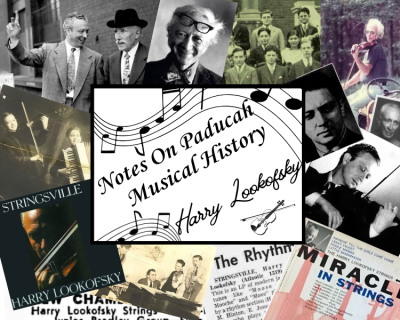
Harry Lookofsky was a violinist whose career spanned numerous genres of American music during the 20th century. Born in Paducah, Lookofsky went on to become a member of the St. Louis Symphony, National Broadcast Company Symphony under Arturo Toscani and the American Broadcast Company Symphony. His album, Stringsville (1959), was revolutionary in the jazz world with the violin being the featured instrument, along with Lookofsky’s pioneering approach to multitracking. He would go onto record on hundreds of albums with the likes of Quincy Jones, Aretha Franklin, Coleman Hawkins, Tony Bennet, Nina Simone, Sarah Vaughn, Louis Armstrong, Burt Bacharach, Sam Cooke, Blood, Sweat and Tears, and others. - Nathan Lynn, Local and Family History
Harry William Lookofsky was born to Jewish immigrants, Ben Lookofsky and Jennie Lottie Dinkin Lookofsky on October 1, 1913, in Paducah, KY. Both parents immigrated from Russia to Paducah, where they married in 1911.1
According to Western Kentucky journalist, Derek Operle, Lookofsky's parents gave him a choice of learning accordion or the violin, when he was 7 years old. With the enticement of his mother offering him a quarter an hour to practice, he picked the violin. At a young age, he reportedly worked in a mailroom, but found there was better money to be made performing with a youth orchestra.2
Lookofsky’s father, Ben worked in the shoe business as a merchant and in shoe manufacturing over the years. They relocated to St. Louis in the early 1920s, where Harry attended Clayton and Soldan High Schools, honing his skills in the school orchestra playing violin. During this time, he performed on Saturday nights with a local trio and around 1926 toured with young St. Louis pianist, Ted Straeter, and sideman Les Leiber.3
The great depression was a hard time and Lookfsky’s mother was no longer able to pay for lessons. His teacher in Creve Coeur continued to offer him instruction for free, which left a lasting impression on him. While in high school he was also provided an opportunity through Mrs. Paul Blackwelder and the Women's Association of the St. Louis Symphony Society for season tickets to the symphony and eventually won an eight-week scholarship to the National High School Orchestra summer camp in Interlochen, Michigan. His cousin Alvin Dinkin also received a scholarship to Interlochen as well. The two would become two of the youngest players to join the St. Louis Orchestra, Harry joining at the age of 20.4
Lookofsky’s widow Sherry Lookofsky would recall in a 2019 interview with Operle, "He and his cousin, who also lived there, would ask for a raise every year from the symphony, and they would get it," Sherry said. "Until one year, they didn't and they quit.'5
"Music was, hands down, the most important thing to him," explained Sherry. "He loved it the most. From little on up, it was the biggest part of his life."6
Lookofsky toured with dance and vaudeville orchestras in the early 1930s and worked with the St. Louis Symphony for several years until moving to New York City in 1938. Once in the big city, he began working with the NBC Symphony at Radio City. But like many Americans during this time would be called to serve during WWII. Harry served with the U.S. Merchant Reserve and performed with the Navy Band.7
After his time in the service, he returned to his position at NBC. His time with the corporation was highlighted by working under acclaimed Italian conductor, Arturo Toscanini.8
"He loved Toscanini and saw him as noble, having high standards and not settling for less," Sherry recalled. "You can play a song cheap or you can play it greatly and I think Toscanini represented that to him."9
He was a member of the St. Louis Symphony, American Broadcast Company Symphony and national Broadcast Symphony under Toscanini. Harry would go on to serve as concertmaster for the ABC Orchestra in 1952.10
Lookofsky took his profession extremely seriously. He was also a member of Musicians Local 802, New York. His instrument was also of the highest quality. Built in 1703 by Joseph Guarneri, his violin was estimated to be worth $10,000 in 1950, around $135,000 in 2025 dollars. 11
“Over the next decades, he performed on all varieties of radio shows and television programs in between stints in the studio and on stage around the country,” noted Operle.12
While Harry had made a career performing in orchestras, he began to fall in love with jazz, despite the violin not being often used as a lead instrument. He became a fixture in New York Jazz sessions13
“Harry just adored Clifford Brown, who played the trumpet, and Charlie Parker, the saxophonist,” Sherry explained. “He just loved that sound and he was trying to recreate it.”14
In 1954 he released his own album, Miracle in Strings, which was arranged by friend Quincy Jones.15
Lookofsky explained his recordings in a 1990 interview with Jon Rose, "In those days, there were no multitrack tape recorders, only single track. So, Epic had me play each string part (three violins, two viola parts) on a separate tape while I listened to the rhythm track, which was itself on a separate tape: Then, lining up six single track Ampex machines, each with a part and all connected to a common "starter" box, they did their best to put it all together. After many starts and stops, together with splicing, they wound up with the album!"16
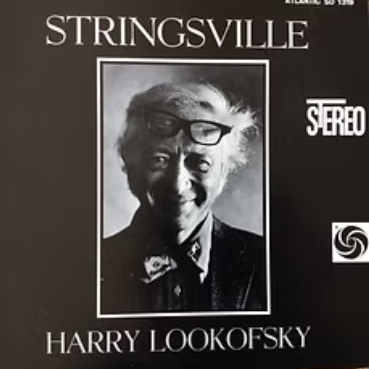
Five years later, in 1959, Lookofsky released his most notable solo work, Stringsville. 17
“Stringsville, challenges the essential rules and definitions of bebop like few records before or since – not only does Harry Lookofsky wield as his weapons violins and violas, but his music hinges as much on technological innovation as it does on technical prowess," wrote Jason Ankeny, a jazz critic with AllMusic. "His performances boast a dark, dramatic edge that pushes the violin into a bold new dimension."18
While most jazz artists played off improvisation, Lookofsky wrote notation before recording, making him susceptible to critics in the jazz world.19
Ralph Gleason’s 1960 San Francisco Chronicle review noted, “This is an LP of modern jazz tunes like, ‘Moose the Mooche’ and ‘Move’ played by a rhythm section (H. Jones, M. Hinton, E. Jones) and a man who plays the violin, viola and tenor violin. Trombonist Bob Brookmeyer joins them occasionally. The music is interesting but rather freakish; the strings are multi-taped and Lookofsky plays them all. It’s a neat trick and the result is pleasant, but not particularly lasting.”20
Others noted that, “Lookofsky trys a multitracking on this and proves the viola and tenor violin are pretty effective jazz instruments too.” 22=1
Lookofsky himself reflected on the album, "I did this on the first multitrack recording machine that was commercially available-it was an Ampех 8 track. We put all the rhythm section down on one track, that left seven. So then I would record using six tracks and then transfer them over to the seventh. Then I would record on five and transfer them over to the sixth, and so on. Some of it was very deceptive, making each part start in a slightly different place, for example. But when you hear it, it sounds like one."22
"He was in awe of those guys who did improvise, but he was not one of them," Sherry said. "He wouldn't have it any other way though. His talent lay in making it sound improvised and making it just swing while being completely in tune. He had the chops and the feel to be able to produce that."23
While some were not ready for progressive jazz violin, critic Gary Kramer states in the liner notes of Stringsville,"Playing well on the violin, from the classical point of view, is almost the complete antithesis of playing well in jazz." Kramer continued, "The more one thinks of all the odds against Harry Lookofsky’s achieving the wonderful, swinging album that he did here, the more one must be impressed with his success. It is a pioneering effort of the greatest possible significance."24
The album features takes on Thelonius Monk’s, “Round Midnight,” as well as,“I Let a Song Out of My Heart,” “Moose the Mooce,” Miles Davis's, "Little Willie Leaps,” “Move,” “Champagne Blues,” “Give Me the Simple Life,” and “Dancing on the Grave.”25
"Well, we put down the rhythm section material in two sessions. It was a very small studio; I remember everyone had to walk sideways to get around the piano and drums. I came just twice to put all the strings down. I knew what I was going to do. There was only one 'second take.' I had to re-record the start of one of the overdubs. You know the equipment was very primitive-each track on the Ampex leaked over into the next one. Apart from that, I don't remember having to do anything over.”26
When Jon Rose asked Lookofsky if he had any desires to become rich and famous, he replied, "No. First of all, I was playing with Toscanini throughout this whole period and I really loved to do that--I didn't want to stop. And I wanted to keep studying; I kept practicing all along. I got up this morning and practiced. I'm really just a violinist. All that traveling, jazz life-well, it really didn't interest me; though I knew the scene quite intimately. I used to get together with Quincy Jones, and we would go down to Birdland and check out all the players. So I knew the musicians very well and I knew the kind of life they had to put up with, and that did not appeal to me. When Toscanini retired, I also quit the NBC and went over to the ABC as concertmaster of their orchestra. I was with them for a long time, and then there were economic cutbacks and they got rid of all the strings. In the last 10 years, I've been doing television jingles-that kind of thing, and playing golf-yes, I like that a lot!” He continued, "You know, after the last time we spoke, I was looking through some old stuff and I came across a tune that Clifford Brown wrote for me. I don't believe anybody else has it because he wrote it for me. Would you like to see it? I can send a copy of it to you. I knew Clifford Brown and felt crushed by the news of his death [June 26, 1956, in Chicago]. A sweeter person never lived, and of course, we all know his playing greatness. When I asked him to write something for me, he graciously said he would, and invited me to his hotel room on Broadway and 53rd Street, New York City. I brought some manuscript paper from ABC, where, at that time, I was working as a staff musician. (At that time, also on the staff, among others, were Billy Butterfield, Bobby Hackett, Peanuts Hucko, and Ruggiero Ricci!) When I entered Clifford's room, he was in his underwear and, while still in that state of dress, sitting on the bed, he dashed off this composition with a solo on the second page."27
Stringsville and Lookofsky’s life work lifted him into new areas of the industry. In 1961 he taught at Lenox School of Jazz. That decade also saw him rise to a premier studio violinst. In 1966 he also helped coproduce the hit song, "Walk Away Renée.” The song was written by his son, Michael Brown, along with Bob Calilli, and Tony Sansone and recorded by the band the Left Banke.28
Lookofsky would go on to record string parts for hundreds of albums during the last half of the 20th century. He can be heard on numerous albums by his friend Quincy Jones as well as with, Coleman Hawkins, Tony Bennet, Nina Simone, Grover Washington Jr, Sarah Vaughn, Louis Armstrong, Wes Montgomery, and Burt Bacharach. The list continues with artists like Aretha Franklin, Blood, Sweat and Tears, Bobbie Charles, Don Mclean, Chaka Khan, Bette Midler, Carly Simon, The Isley Brothers, Sam Cooke, and more.29
Operle notes that Lookofsky and Jones became friends in the New York jazz circuit during the 1950s. This would lead to years of work together in the industry.30
"When Quincy would send him a tape, Harry would just disappear into the basement for a few weeks, only coming up for air and food," Sherry said. "He talked about his solo on 'What's Going On' (Quincy Jones' cover of the Marvin Gaye classic) a lot. It was way ahead of its time, truly space age the way the violin comes in and then goes out into the stratosphere."31
He continued to record and perform through the late 1980s, and grew to become highly respected in the entertainment industry. 32
"Lookofsky's playing has the sophistication and power of a classic bebop horn player, a Charlie Parker or a Sonny Rollins," Rose wrote.33
Harry Lookofsky died on June 8, 1998 at his home from complications of prostate cancer. He was survived by his wife of 15 years, Susan Kruger Lookofsky, and six children, Joseph Lookofsky, Michael Brown, Peter Lookofsky, Jayne Lookofsky, Mary Lookofsky, and Susan Lookofsky. A memorial service was held at Unitarian Universalist Congregation of York Church34
Reflecting on the kindness of his childhood teachers and the Ladies Auxillary of the St. Louis Symphony, The Harry Lookofsky Memorial Scholarship was set up with the Church Street School for Music and Art, in New York. For more information visit https://www.churchstreetschool.org/_files/ugd/de47a3_25cfbb25429043b3af8d647c78fe9dcd.pdf 35
According to Wikipedia, Lookofsky's archives were left to the American Roots Program at Berklee School of Music in Boston.36
For more information on Harry Lookofsky and other area musicians, visit the McCracken County Public Library Local and Family History Department.
Footnotes:
1Year: 1920; Census Place: Paducah, McCracken, Kentucky; Roll: T625_588; Page: 4B; Enumeration District: 143
Source Information: Ancestry.com. 1920 United States Federal Census [database on-line]. Provo, UT, USA: Ancestry.com Operations, Inc., 2010. Images reproduced by FamilySearch.
Original data: Fourteenth Census of the United States, 1920. (NARA microfilm publication T625, 2076 rolls). Records of the Bureau of the Census, Record Group 29. National Archives, Washington, D.C. For details on the contents of the film numbers, visit the following NARA web page: NARA. Note: Enumeration Districts 819-839 are on roll 323 (Chicago City).
“Harry Lookofky, Violinist.” The York Daily Record, Jun 15, 1998. https://www.newspapers.com/image/555157726/?article=91bff13c-3807-4120-b86d-e650e6dc1cd6&terms=%22Harry%20Lookofsky%22
“Russian Couple Married...” The Paducah Evening Sun. Mar 30, 1911. https://paducahsun.newspapers.com/image/1187924015/?match=1&terms=%22Ben%20Lookofsky%22
Source Citation: National Archives at St. Louis; St. Louis, Missouri; Wwii Draft Registration Cards For New York City, 10/16/1940 - 03/31/1947; Record Group: Records of the Selective Service System, 147
Source Information: Ancestry.com. U.S., World War II Draft Cards Young Men, 1940-1947 [database on-line]. Lehi, UT, USA: Ancestry.com Operations, Inc., 2011.
2 Operle, Derek. “Innovative jazz violinist....” The Paducah Sun. Feb 3, 2019. https://paducahsun.newspapers.com/image/593272560/
3“Harry Lookofsky Memorial Scholarrship.” Church Street School. Accessed December 16, 2025. https://www.churchstreetschool.org/harrylookofsky.
Year: 1920. Source Citation: Year: 1930; Census Place: St Louis, St. Louis (Independent City), Missouri; Page: 7B; Enumeration District: 0211; FHL microfilm: 2340979
Source Information:Ancestry.com. 1930 United States Federal Census [database on-line]. Provo, UT, USA: Ancestry.com Operations Inc, 2002.
4 Operle
“Harry Lookofsky Memorial Scholarrship.” Church Street School. Accessed December 16, 2025. https://www.churchstreetschool.org/harrylookofsky.
Kerby, Damon, “Developing Young Musicians..” The St. Louis Post-Dispatch, Feb 24, 1938. https://www.newspapers.com/image/573394959/?match=1&terms=%22Harry%20Lookofsky%22
“Interlochen Camp Auditions..” The St. Louis Globe-Democrat, Apr 5, 1940. https://www.newspapers.com/image/573394959/?match=1&terms=%22Harry%20Lookofsky%22
“Symphony Scholarships..” The St. Louis Globe-Democrat, Apr 16, 1936.
https://www.newspapers.com/image/573370801/?match=1&terms=%22Harry%20Lookofsky%22
5 Lookofsky, Sherry (Quoted by Operle)
6Lookofsky, Sherry (Quoted by Operle)
7“Harry Lookofsky Memorial Scholarrship.” Church Street School. Accessed December 16, 2025. https://www.churchstreetschool.org/harrylookofsky.
“Harry Lookofky, Violinist.”
"Toscanini Leads Here...” The Times-Picayune, Apr 23, 1950, 1950. https://www.newspapers.com/image/1248907032/?match=1
Operle
8“Harry Lookofky, Violinist.”
Operle
9 Lookofsky, Sherry (Quoted by Operle)
10 “Harry Lookofky, Violinist.
Myers, Marc. “Jazz News: Harry Lookofsky: Stringsville.” All About Jazz, October 1, 2015. https://www.allaboutjazz.com/news/harry-lookofsky-stringsville/.
“Harry Lookofsky Memorial Scholarrship.” Church Street School. Accessed December 16, 2025. https://www.churchstreetschool.org/harrylookofsky.
11“Harry Lookofky, Violinist.”
"Toscanini Leads Here...” The Times-Picayune, Apr 23, 1950, 1950. https://www.newspapers.com/image/1248907032/?match=1
Maksian, George. “Radio Roundup.” The New York Daily News, Feb 3, 1985. https://www.newspapers.com/image/487127720/?match=1&terms=%22Harry%20Lookofsky%22
https://www.measuringworth.com/dollarvaluetoday/?amount=10000&from=1950
12 Operle
13 Operle
“Harry Lookofsky Memorial Scholarrship.” Church Street School. Accessed December 16, 2025. https://www.churchstreetschool.org/harrylookofsky.
14 Lookofsky, Sherry (Quoted by Operle)
15 “Harry Lookofsky Memorial Scholarrship.” Church Street School. Accessed December 16, 2025. https://www.churchstreetschool.org/harrylookofsky.
16 Rose, Jon. “Harry Lookofsky: On the Phone to a Jazz Legend.” Strings, 1990.
https://www.churchstreetschool.org/_files/ugd/de47a3_25cfbb25429043b3af8d647c78fe9dcd.pdf
17 Operle
18 Ankeny, Jason. “Harry Lookofsky Songs, Albums, Reviews, Bio & ...” AllMusic. Accessed December 18, 2025. https://www.allmusic.com/artist/harry-lookofsky-mn0000847739. (Quoted by Operle)
19 Operle
20 Gleason, Ralph J. “The Rhythm Albums,” The San Francisco Chronicle, May 29, 1960. https://www.newspapers.com/image/1239618408/?match=1&terms=%22Harry%20Lookofsky%22
21 “Records.” The Quad-City Times, May 8, 1960. https://www.newspapers.com/image/301782743/?match=1&terms=%22Harry%20Lookofsky%22
22 Rose, Jon
23 Lookofsky, Sherry (Quoted by Operle)
24 Harry Lookofsky. Stringsville. Vinyl recording. Collectables, n.d. (Quoted by Operle)
25 Rose, Jon
26 Rose, Jon
27 Rose, Jon
28 “The Left Banke - Walk Away Renée / Pretty Ballerina.” DiscCogs. Accessed December 16, 2025. https://www.discogs.com/release/3179232-The-Left-Banke-Walk-Away-Ren%C3%A9e-Pretty-Ballerina.
29Gleason, Ralph.“Jam Sessions Gone...” The Des Moines Register, Jun 3, 1961. https://www.newspapers.com/image/128555938/?match=1&terms=%22Harry%20Lookofsky%22
Operle
“Harry Lookofsky Discography: Vinyl, Cds, & More | Discogs.” DiscCogs. Accessed December 16, 2025. https://www.discogs.com/artist/135849-Harry-Lookofsky.
30 Operle
31 Lookofsky, Sherry (Quoted by Operle)
32 Operle
33 Operle
Rose, Jon. “Stringsville.” The Jon Rose Web - Stringsville. Accessed December 16, 2025. https://www.jonroseweb.com/c_articles_stringsville.php.
Rose, Jon
34Operle
“Harry Lookofky, Violinist.”
35 “Harry Lookofsky Memorial Scholarrship.” Church Street School. Accessed December 16, 2025. https://www.churchstreetschool.org/harrylookofsky.
36 “Harry Lookofsky.” Wikipedia. Wikimedia Foundation, September 2, 2025. https://en.wikipedia.org/wiki/Harry_Lookofsky.