
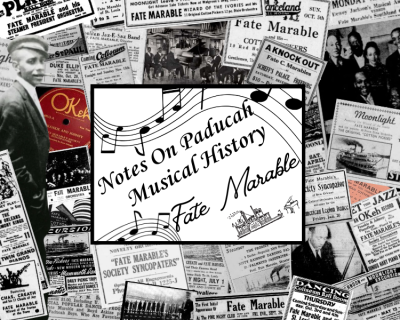
Paducah native, Fate Clifford “River” Marable (1890 – 1947), is often referred to as the father of Riverboat Jazz. Starting in 1907, he worked on Streckfus Steamer excursion boats, performing on the Mississippi and Ohio rivers for nearly 40 years, and working clubs in port cities like New Orleans, St. Louis, and Pittsburgh. A pianist and calliopist, he was also a director, band leader, teacher, and talent scout, discovering and training some of the most notable jazz musicians of the era. - Nathan Lynn, Local & Family History
Internationally known artist, Fate Clifford Marable was a pianist and bandleader, referred to as the father of Riverboat Jazz. Born on December 2, 1890, to James Marable and Elizabeth ‘Lizzie’ Whorton Marable, in Paducah, KY, he had five siblings: Mable, James, Neona, Harold, and Juanita. James worked as a teamster and Lizzie was a music educator. Lizzie was part Irish and herself a notable for her triumphs in music education in the area. She taught Marable to read music and play the piano.1
Marable and his siblings grew up on South 7th and 8th Streets in Paducah’s historic Southside, making his first reported appearance as an entertainer in the Paducah Sun in 1896. He graduated from Lincoln High School on May 7, 1907, by which time he was appearing frequently in the local newspapers for his performances, often alongside his classmate, neighbor, and future Chicago notable musician, Ida Mae Baker. The same year, legend tells, Marable heard the calliope on a Streckfus Steamers steamboat at the port of Paducah and inquired about a job performing aboard, at the suggestion of replacing pianist Charlie Mills. This began a career with Streckfus that lasted nearly 40 years on the Mississippi and Ohio Rivers. 2
In 1909 he married Rosa Caldwell in Massac County and the couple continued to call Paducah home, residing at 512 South 8th St. But Marable’s life became increasingly more devoted to river and music over the next decade. Working for Streckfus, he was tasked with both playing the calliope and leading the house band. By 1912 he was making a name for himself on the rivers as one reporter noted, “Then last but not least, there is Fate Marable, generally conceded to be the premier harmonic tooter of the Mississippi. There are calliope players and then more calliope players, but when Fate allows his fingers to wonder dreamily over the brass keys all lovers of rag time sit up and take notice.”3
The calliope was played when boats arrived and departed from ports. It was located on the top of the boat due to the mist of hot cylinder oil, steam, and ash that rained down on players. The instruments projection worked off some 80 lbs of pressure that ran through pipes to brass whistles when the keys were pressed. The sheer loudness caused players to have to stuff cotton in their ears, and the heat on the keys caused them to wear gloves. Such players were known as Professors, a title that Fate himself would earn. Even as a trained pianist, he found the job challenging due to the difficulty of having to hold down the pressured hot keys. The instrument lent itself to old standards like, “My Old KY Home,” “Turkey in the Straw,” and “Oh! Them Golen Slippers.” It's of note that President Theodore Roosevelt once danced to Marable playing “Turkey in the Straw,” on the calliope.4
Life working on steamboats was dangerous. Marable worked the early Streckfus steamer J.S. and on June 25, 1910, while the band was performing, the ship caught fire, putting him temporarily out of work.5
Regardless, he began to find new notoriety as a performer, as the Streckfus company precured him with more responsibility. Historian Willaim Howland Kenney, author of Jazz on the River, noted that he “carried himself like a sailor, wearing hats cocked at jaunty angle and special steamboat stogie clamped between his teeth.”6
Kenney notes that Marable’s early bands on Streckfus boats included Charlie Hertzog (violin), Tony Catalano (cornet), Rex Jessup (trombone), and Emil Flindt (violin) whom were all white musicians, but from the end of WWI through WWII, segregation grew and Marable lead all Black bands until the end of his career.
He worked the J. S. No. 1, noting, “It sailed to New Orleans that year with me at the piano and a white fellow playin the violin. That's all we had. Each year,” Marable continued, “we added one more piece until we had what we thought was a great big band. Four pieces – piano, violin, trumpet, and drums. All of them were white boys but me and playing strictly ragtime.”7
In 1916 Marable published his first composition, “the Barrell House Rag,” coauthored with Clarence Wiliams and published by Williams and Piron Music Publishing Company.8
The next year, in 1917, due to increasing racial tensions, Marable formed his first all-Black band. Kenney notes that he chose musicians from Paducah and called them the Kentucky Jazz Band. The group traveled to New Orleans at the end of that season. While Marable was a ragtime musician for years, his time in the NOLA, St. Louis, and Chicago night life brought him new sounds and furthered his own education. Marable noted in Beulah Schacht’s, “Riverboat Jazz,” in the St Louis Globe-Democrat, July 22, 1945, “I could read because my mother was a piano teacher and I studied later at Straight University in New Orleans.” 9
Louis Armstrong noted, “Every musician in New Orleans respected him. He had seen the good old days in Storyville, and had played cotch with the pimps and hustlers at the Twenty-Five gambling house. He had had fine jam sessions with the piano greats of the days.... He always won the greatest honors with them.”10
Fate Marable noted, “We were playing in and out of New Orleans all the time and I began to notice the type of music they were playing there. It really got under my skin.” 11
That winter, Marable heard the young Armstrong playing cornet with Kid Ory’s Co-Operative Hall Band. Soon Armstrong, along with drummer Warren “Baby” Dodds; bassist, George “Pops” Foster; Banjoist Johnny St. Cyr; mellophonist, David Jones; clarinetist, Sam Dutry; trumpeter, Joe Howard; and trombonist William “Bebe” Ridgley joined Marable and the Streckfus line for a trip upriver. The musicians had been used to playing by ear in New Orleans famous, Storyville, but they would spend a year rehearsing and learning to read music. With the closing of Storyville, Fate offered musicians work.12
Marable's early years on the American inland waterways had found him performing ragtime music accompanied by a violinist. But nearing a decade of river life, he was coming into his prime and developing new sounds. He had built the quintessential Riverboat Jazz band and what would be the most notable band he would ever lead. The group went by “The Metropolitan Jaz-E-Saz Orchestra,” “Fate Marable and the Cotton Pickers,” or “Fate Marable's Society Syncopators.” The band would define not only riverboat jazz for decades to come but also set the stage for all of the performers to grow out of the river's banks and out into the world. 13
With an orchestra of that size, the group rehearsed dynamics and ways to fill the sounds of the large dance halls they performed in on the boats. A lot has been written about Joseph Streckfus and his push to make that band play 70 beats per minute; choose the songs the band played; set moonlight cruses from 9 PM to 12 AM, with 14 songs, with every fourth tune being a waltz. Regardless, with Streckfus‘ influence, the group developed a distinct sound and found ways to swing and improvise.14
Kenney notes that it's hard to imagine Joseph Streckfus as the owner of the company, having much time to attend band rehearsals, leading readers to believe Marable and said musicians had more influence on the music than Joe claimed.15
Kenney goes on, “The first thing Marable did with his first New Orleans band was to take them north by train, not to the St. Louis offices of Streckfus Steamers but to Paducah, Kentucky, where he got them, all signed into the local of the Black musicians’ union. This was Marable’s hometown, of course, and perhaps the local musicians were willing to settle for a statement that Fate’s recruits could read music. In St. Louis, one had to audition by sightreading a piece not seen before. Once they were union members, however, they could readily transfer their membership to the St. Louis local.”16
Marable has often been depicted as hard to work for; reportedly firing musicians by putting a fire axe in their room; expecting them to stand at their place until he entered and sat down at his piano; fining his players if they drank, while being known to drink himself. Marable insisted musicians control their instruments, read music, compose, arrange, and join a union. Many musicians that Fate hired were great at improvision but needed assistance learning to sight read. The trumpeter Clark Terry recalled that while rehearsing a new piece written in the key of F major, Marable would proceed to modulate to F# major, just to watch his musicians panic. 17
During Armstrong’s years working with Marable, the band leader insisted on him learning to read music. Armstrong seemed uninterested and would go on to prove that improvisation could lead to success. But Armstrong was an exception. Many others needed the lessons. Kenney notes that Al Morgan and Floyd Campbell both contributed their success to Marable's conservatory. 18
Marable was strict with his band members and insisted they learn to read music. While Armstrong and others often fought and opposed it, it nonetheless gave the musicians education that they would carry with them.
“Lots of those jazz musicians couldn’t read music – never mind an arrangement. I could read myself because my mother was a piano teacher and I studied later at Straight University in New Orleans, but sometimes, there was only one man in a jazz band who could read.”19
“I Still think it is good psychology,” Armstrong noted, “Fate Marable’s band deserves credit for breaking down a few barriers on the Mississippi – barriers set up by Jim Crow. We were the first colored band to ply most of the towns at which we stopped, particularly the smaller ones. The ofays were not used to seeing colored boys blowing horns and making fine music for them to dance by.”20
1919 found Marable, Armstong, Howard, Samuel Dutry (Trombone), St. Cry, Foster, and Dodds playing in what would be Armstrongs first trip to St. Louis, all as members of the Musicians Union Local 44.21
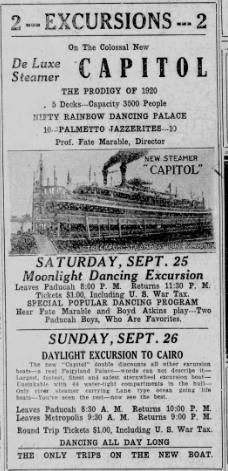
Through WWI, Marable kept his residence on Paducah’s south side, but his life on the river often kept him away from home. In December of 1917, Fate and Rose divorced. By 1918 he began to appear frequently in St. Louis newspapers. Newspapers along the Mississippi began to mention him more often, promoting his performances on excursions. By 1920 he had taken the title, “Professor.” It was during this time that the most famous riverboat jazz band worked under his direction. 22
“It was an entirely different kind of music than ragtime which preceded it or the swing which followed. While ragtime, like jazz was born and bred in New Orleans, St. Louis accepted it and some of the finest ‘rags’ ever written were written here.”24
A style defined by its upbeat tempo of older standard songs along with arrangements of popular commercial songs with instruments playing slightly different takes and rhythmic emphasis at an upbeat tempo, performed by a jazz orchestra, with Marable as the conductor.23
He dressed well and loved the nightlife and dance hall scenes along the river and in the bigger cities of St. Louis, Chicago, NOLA, and Pittsburg. He was known for loving female companionship, cigars, fine whiskey, and betting on horses. 24
Jess Stacy, who would go onto play with Benny Goodman, was born at Birds Point and first heard Marable in 1920. The boat visited Cape, Girardeau numerous times, and Stacey was able to hear Marable’s band with Armstrong. “You can’t imagine such energy, such musical fireworks as Louis Armstrong on that boat. The music sounded so good out on the river. They go out in the middle. . . And the paddlewheel would be turning slowly to keep it from drifting downstream. People dance there. That band carried me away. When I heard that band, I said, ‘ that’s what I want to be. I want to play on the river boats.’”25
Warren Baby Dodds noted, “that was a wonderful band. The music with sound, so pretty, especially on the water. . . Sounded so beautiful on the water...”26
After about three years, working on the river, Armstrong and Dodds left Marable’s band. Zutty Singleton replaced Dodds, and Marable eventually hired the great Red Allen. The rest of the great band slowly dispersed as well, with Marable scouting and hiring the best musicians he could find in the towns along the American Inland Waterways. 27
In September of 1920, the Paducah Sun reported that Paducah legend Boyd Atkins had joined Marable's Palmetto Jazzerites. By May of 1921, the band featured Atkins, Norman Mason, David Jones, and Henry Kimbal. The early 1920s found the band performing in St. Louis, Paducah, and other river cities when not aboard. 28
During the late teens, Marable and the band spent lots of time playing out of New Orleans for part of the season and by the early 20s around St. Louis in places like Decatur, Taylorsville, Belleview, Edwardsville, and Alton. They were celebrated in St. Louis playing Demonte Dance Palace, Pythian Hall, Douglas Hall, and Stars Baseball Park. In 1923, newspapers called Marable the “Wizard of the Ivories.” Steckfus kept them busy with work with moonlight excursions for nearly a 1000 people. While they were extremely busy in NOLA, they made stops in Paducah and Mayfield for offshore performances.
Fate eventually left Paducah. And in May of 1922 married Isadora Matlock in St. Louis. The couple had three kids would have three kids, Fate Jr, William, and Isadora.29
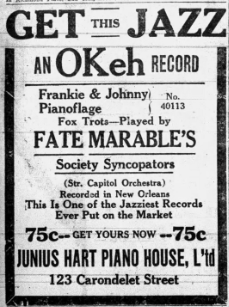
On March 16, 1924, Fate Marable and His Society Syncopators recorded two sides for Okey Records in New Orleans, LA. The band featured Marable on Piano; Bert Bailey, Clarinet and Alto Saxophone; Sidney Desvignes, Trumpet; Harvey Lankford, Trombone; Henry Kimball, Bass; Narvin Kimball, Banjo, Guitar; Fate Marable, Piano, Conductor; Zutty Singleton, Drums; Walter Thompson, Tenor and Baritone Saxophone; Amos White, Trumpet. The first side was the American folk song, Frankie and Johnny (Okeh40113) and ragtime number Pianoflage (40113-B).30 At the time it was called one of the jazziest albums ever put on the market,” but would be the only recordings Marable made.31
In 1925 the band featured Marable, piano and director; Burrows Lovingood, piano; Dewey Jackson, cornett; Norman Mason, saxophone; Nathaniel Story, trombone; Art Kimbell, tube; Floyd Campbell, drums. When not doing Streckfus excursions, the band found time to perform in Davenport, and Rock Island. November and December found Marable performing numerous dates in his hometown, Paducah, including New Years Eve at the Paducah Elks Club.32
In 1926 Marable continued playing in Paducah at numerous engagements throughout the spring, but the river called. The late 20’s saw the band continuing to perform for excursions on the JS Deluxe, Capitol, St. Paul. During off times the band also found time to work at numerous venues around St. Louis like, Paradise Dance Palace, and West Lake Dance Palace.
It is of note that while most Streckfus excursions featuring Marable and his bands were for white patrons, the band also played separate excursions for Black patrons. Marable and his band were revered in Black newspapers and while much has been written about Marable and race relations, readers can find more on the topic in Kenney’s Jazz on the River.
Through the years, Marable remained a staunch union man. In 1929 he along with numerous colleagues spoke out publicly rallying support towards local musicians over ‘canned music,’ in clubs.33
In January 1930, Marable's band consisted of Cecil Thornton, John Young, Nathaniel Story, Earl Martin, Eugene Hutt, Albert Sneal, Norman Mason, William Humpheries, Albert Morgan, and Marcellus Sherrod. Dewey Jackson also continued to perform on and off. By this time newspapers up and down the Mississippi River were advertising for excursions on the Capitol, Deluxe, and St. Paul, featuring the Southlands Greatest Band of Fate Marable. That summer the band Marable’s Southland Orchestra and Dewey Jackson’s Musical Ambassadors were billed on numerous dates 'battling,’ on the J.S. Deluxe, St. Paul. When off the boat the band appeared at the Pine Night Club, Paradise Dance Palace, St. Louis, as well as the Danceland Ball Room, Davenport, IA, and Paducah’s Hook’s Park with Bert Futrell and his Harmony Kings of Paducah.34
They spent the winter in New Orleans on Capitol and by June the band was made of Horace Millner, sax, clarinet, mellophone; William Humphrey, sax and clarinet; Albert Snaer, trumpet, slide cornet, vocals; Eugene Hutt, trumpet; Nathaniel E. Story, trombone, vocals; John Young, tenor banjo, steel guitar, piccolo, harmonica, vocals; Albert Mogan, tuba, string bass, and vocals; Gerald Hopson, drums, bells; Marable, piano, director, arranger.35
The 1930 US Federal Census list Fate and Isadora renting at 1302 South Telemachus, New Orleans, 14th ward, but for most of the 1930s he resided in St. Louis, where he would live for the rest of his life. By 1932 the couple was back living at 4220 Enright in St Louis and by 1933, they were living at 4430 Aldine Av.36
In 1931, the St. Louis Argus reported the band featured Nathan Stanley and Willie Tomlin, cornets; Willie Austin, trombone; Johnson, on brass; Horace Milliner, Joe Nevils, Earl Caruthers on reeds; Willie Austin, trombone; John Young, banjo and entertainer; A. G. Godley, drums; Vernon King, bass; Marable on piano. “Upon close observance we find that this year Marable has produced an orchestra that excels all others used in previous years. ‘Tiger Rag,’ ‘Mood Indigo,’ ‘Black and Tan Fantasy,’ ‘The Peanut Vender,’ and a galaxy of sweet numbers are included in their program. Singing trio, composed of Milliner, Young and Austin is also featured. Caruthers, remembered here in former years as the leading tenor ‘saxer,’ is playing alto ‘a-plenty.” The band also performed the numbers, “Million Dollar Baby,” “Two Hearts in Three Quarter Time,” “Bottle Melody,” “Baby’s Birthday Party,” “Smile Melodies,” “Bottle Melody,” “Baby’s Birthday Party,” drum solos, and more. The fall of 1931 the band was stationed in St. Louis working clubs but did make one trip to Paducah in November. 37
Early 1932 found Marable playing around St. Louis at the Jeffla, Phythian Hall, Sauter’s Park (billed as Dewey Jackson and Fate Marable’s Harlem Stompers), along with radio dates on WIL. They also played engagements in Alton and Mascoutah. 38
In February of 1933, the group returned to the Capitol in New Orleans, with Jesse Price on drums. That summer they returned to St. Louis on the St. Paul. The same year Elmwood Buckhanon joined the band, and they returned to Sauter’s Park to play with the Kentucky Serenaders. In the fall Marable and the band performed on the S.S. President, making numerous stops down the Mississippi including at Perryville, Hayti, and Caruthersville, MO, Cairo, IL, Hickman, KY, Memphis, TN, Friar’s Point, MS, Helena, AR, Vicksburg, MS, Greenville, MS, and NOLA, where the finished the season before transferring back to the Capitol in early December. They would stay working out of NOLA until May of 1934 when they returned to St. Louis making similar stops. Back in St. Louis they again performed on the St. Paul and were joined by Charles Creath and Dewey Jackson for numerous dates. That summer Marable also played piano in Creath’s Famous Band, along with Dewey Jackson, on excursions down the Mississippi and up the Ohio Rivers, making a stop in Paducah on September 12. He would stay with Creath and the Eleven Clouds of Joy, working the lower Mississippi through the summer of 1935 when they returned to St. Louis. Marable continued to work with Creath through 1936 with both sharing billing titles, basing out of St. Louis, and traveling the lower Mississippi. Also of note, in July of 1936, Marable presented Fats Waller and His Orchestra in New Orleans.39
In 1937 Creath and Marable found themselves working on the Ohio River as, “Creath’s 12-pc Cotton Pickers featuring Fate Marable, King of the Ivories.” The group ended in Pittsburg on the Streckfus St. Paul, with stops along the way in numerous river ports as usual. Later that year they would appear as Fate Marable and his 11 Clouds of Joy, back on the Capitol, working on the lower Mississippi and NOLA. They returned to St. Louis in the spring of 1938 where they rehearsed before leaving for Pittsburg on May 4th aboard the St. Paul. Along the way they made stops in Paducah, Tell City, Owensboro, Evansville, Louisville, Maysville, Madison, Carrolton, Portsmouth, East Liverpool, and other river towns. The group spent the summer in Pittsburgh before returning down river to St. Louis in the fall, performing along the way. They spent the last of the year performing around the St. Louis area. 40
Early 1939 the group performed numerous shows around the St. Louis area and in February headlined the NAACP Farm Jamboree at the Castle Ballroom to a capacity crowd. They would soon return to the waters heading back up the Ohio and making similar stops as they did the previous year, including Paducah, before landing in Pittsburg for another summer. While Marable's already had a reputation for his years of river life in the city, on Thursday, August 10 Marable and his Serenaders made their first night club appearance at the El Congo starting at 12:30 AM. The group performed through August 20 before returning down the Ohio. 41
Kenney claims that Fate Marable reached Pittsburg, “as early as 1907.” His family would eventually move to the city, “while he steamed the inland waterways.” He goes on to state, “Marable first arrived in Pittsburgh during the ragtime era and came back yearly throughout the initial rise of jazz and the evolution of swing.” He goes on to mention the 1940 WPA survey stating, "Fate Marable carried jazz up the Mississippi and Ohio to every town along the banks. He himself played it. He picked up one man after another, trained him soundly in musical technique, and watched him leave the river to carry the gospel into cities inland, on lake shore, prairie, and mountainside from coast to coast.” When in Pittsburgh, Marable played the Crawford Grille, in the Bailey Hotel, and clubs along Wylie Avenue.42
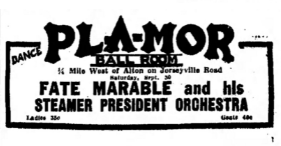
Marable spent the fall of 1939 performing at St. Louis’ Club 49 and Playmore Ball Room as Fate Marable and his Steamer President Orchestra. Club 49 was a popular spot for celebrities. Duke Ellington was a frequenter at the time working to recruit the great Jimmy Blanton who was playing bass in Marable's band.43
By 1940, Marable had established himself as a staple in the list of jazz greats of early New Orleans like Joe Oliver, Kid Ory, Sidney Bechet, and Louis Armstrong. St. Louis Argus writer, J. Von Chapman, began to refer to Marable as “Old Man River,” and others as just, “River.”44
Life on the river came with some danger. As noted early in Marable’s career, the band played through a fire. Also, one night on the St. Paul a knife fight broke out 5 miles South of St. Louis. The agitators came on the bandstand, but the band played on one musician noted, “I don’t care what they do as long as they don’t break this snare – it set me back 30 bucks.”45
Kenney notes that "Marable was still playing piano and calliope, recruiting and organizing musicians, and directing the hot riverboat dance bands as the United States prepared to enter WWII. His unmatched career on the excursion boats became a major symbol of new opportunities for blacks in a more highly professionalized music business. Marable’s life and position represented important transform action in black riverine culture.”46
Marable and the band performed around St. Louis during the spring of 1940 before leaving in April for a return trip to Pittsburgh, starting their summer excursions in the Steel City on July 14th. The season lasted until late August when he returned to St. Louis. This would be his last trip as band leader the riverboat excursion industry declined with the war.47
In early 1941 Marable ended up in the Marine Hospital in Kirkwood, MO, reportedly, “penniless”. A farewell party was thrown at the Foxes Social Club in St. Louis and Marable traveled to New York. The New York Age reported that on February 17, 1941, the Minor Chord Club with Nat Story as President hosted a benefit to raise money in hopes to bring Marable, “back to New York where he can spend his remaining days in peace and companionship of friends.” 48
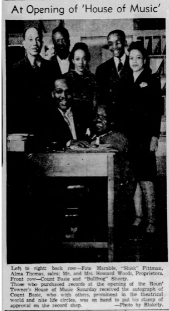
While unsure of Fates underlying conditions, by April Fate was back in St. Louis making an appearance at a local record store opening, alongside Count Basie. The New Pittsburgh Courier reported that Marable would not be performing there that summer, but Fate did continue to appear around St. Louis. That June he began playing at the Club 93 Gardens on Natural Bridge Rd on the outskirts of St. Louis where he would perform through September of 1942. That November, he moved to the Cafe Society at the West End Hotel. The band supported Una Mae Carlisle there in December. The band featured Floyd Smith on guitar at this time. 1942 also saw the band headlining the Chicago Club, 217 S. Seventh St. St. Louis.49
By late September 1942, Marable's band was seeing the effects of WWII. The band does not seem to appear in newsprint with Marable noting that, “if the army would release his two key men, Pee Wee Claybrook and Harold Baker, he’ll start tomorrow.”50
In July 1945 Marable was playing the Victorian Club, 3719 Washington Blvd., St. Louis. That year he took time for an interview with journalist Beulah Schacht, “I miss those days sometimes, but 1907 is a long way from 1940, and I think I’ve added 10 years to my life by giving up the worry of taking care of an orchestra. We sure had great fun though.”51
“I firmly believe that New Orleans and Louis Armstrong have done more for the present dance band than any other factors for the simple reason that Louis is New Orleans style personified, and he is copied by instrumentalists and singers alike.”52
“The music of today seems to lack that fire that it had in the old jazz days, and some of the present bands are using arrangements copied from things we did in New Orleans in 1912. My favorites in the field today are Benny Goodman – and let me tell you that white people can play the Negro’s jazz although some will say no – Louis Armstrong, Count Basie, Woody Herman, the King Cole Trio and Red Allen”53
At the time Marable was living at 4179 West Belle Pl. He finished the year playing local engagements and that November he visited his family in Pittsburgh.54
In January of 1946 Marable traveled to Chicago to perform with an all-star band at Floyd Campbells’ holiday gala alongside Campbell, Eddie Penninger, Billie Brown, Joe Williams, and Alice Roberts. The same month he traveled to California. That May he and a 6-piece band played at Diamond Mineral Springs.55
On January 4, 1947 Fate was admitted to Homer G. Phillips Hospital. His former wife Isadora, along with their three children, traveled to St. Louis and all gave transfusions in an attempt to save his life. The Chicago Defender noted that on Wednesday January 15th Fate slipped into unconsciousness after “faintly smiling at a large bouquet sent by Louis ‘Satchmo’ Armstrong.”56
On Thursday, January 16, 1947, at 6:30 PM, Fate Clifford Marable died of pneumonia at Homer G. Phillips Hospital in St. Louis. He had been sick for about three weeks. A funeral arranged by Randle Funeral Home and Mundy Funeral Home was held in Paducah on Monday, January 20th with burial in Oak Grove Cemetery. He was survived by Isadora, Isadora Jr., Fate Jr., and William.57
News of Fates death was reported across the continent with the St. Louis Globe-Democrat noting, “Fate Marable was always noted for his kind spirit and encouraging guidance toward young musicians.”58
He was loved by many people. Louis Armstrong noted, “I started a band of my own for awhile and then I got a job with Fate Marable playing on the St. Paul up and down the river. Fate who lives here in St. Louis now was responsible for lots of us youngsters getting a start and there were a lot of good men in his bane. We were the first hot band to come up on the boats and people thought we were really something out of the ordinary. Baby Dodds used to play on the rims of the drums, y’know.”59
Marable was responsible for providing so many musicians with work and education including Louis Armstrong, Red Allen, Harold Shorty Baker, Tab Smith (Count Baise), Clark Terry, Jimmy Blanton (Duke Ellington), Joe Howard, Bebe Ridgley trombone, Boyd Atkins, Sidney Desvignes, David Joens, Johnny Dodds, Sam Dutrey, Norman Mason, Druie Bess, Gene Sedric (Fats Waller), Walter Fats Pichon, Tallmadge “Tab” Smith, Nathaniel Story (Chick Webb) , Earl Bostic Irving Randolph (Mills Blue Rhythm Band) and more.60
Throughout his career he worked under numerous band names including the Kentucky Jazz Band, Metropolitan Jaz-E-Saz Orchestra, Fate Marable and the Cotton Pickers, Fate Marable's Society Syncopators, Fate Marable's Harlem Steppers, Fate Marable's Society Orchestra, New Orleans Harmony Serenaders, Ten Gold Harmony Kings, The Jazzcopaters, Famous Cotton Pickers, Southland Orchestra, Fate Marable and the Rythm Stompers and more.61
Marable was far more than a pianist and band leader. He was a teacher and recruiter, discovering and training some of the most notable jazz musicians of the era. He was a businessman and union advocate and helped prepare numerous musicians for their migration from the South to the jazz cities of the North. Kenney notes of Marable, “His (life) became the longest and most influential career in riverboat jazz, a masterful negotiation of the undertow of the jazz life, the hazards of those old boats, and the ever-present dangers of racial segregation on board and in the many river cities from New Orleans to Pittsburgh.”62
Like the excursion steamboats that drifted into memories on the American inland waterways, riverboat jazz and the kings that defined the era live on in legend. Fate Marable is forever the fabled captain of Paducah’s jazz heritage.
Footnotes:
1 Marable, Fate Clifford, death certificate, January 16, 1947file number 2849, Missouri Office of the Secretary of State; Jefferson City, MO, USA; Missouri Death Certificates, 1910-1969: Source Information: Ancestry.com. Missouri, U.S., Death Certificates, 1910-1971 [database on-line]. Lehi, UT, USA: Ancestry.com Operations, Inc., 2015.Original data: Missouri Death Certificates. Missouri Secretary of State. http://www.sos.mo.gov/records/archives/archivesdb/deathcertificates/: First accessed 24 August 2014.
Source Citation: Year: 1900; Census Place: Paducah Ward 5, McCracken, Kentucky; Roll: 540; Page: 3; Enumeration District: 0070 Source Information: Ancestry.com. 1900 United States Federal Census [database on-line]. Lehi, UT, USA: Ancestry.com Operations Inc, 2004. Original data: United States of America, Bureau of the Census. Twelfth Census of the United States, 1900. Washington, D.C.: National Archives and Records Administration, 1900. T623, 1854 rolls.
Source Citation: Year: 1910; Census Place: Paducah Ward 4, McCracken, Kentucky; Roll: T624_493; Page: 19b; Enumeration District: 0120; FHL microfilm: 1374506, Source Information: Ancestry.com. 1910 United States Federal Census [database on-line]. Lehi, UT, USA: Ancestry.com Operations Inc, 2006. Original data: Thirteenth Census of the United States, 1910 (NARA microfilm publication T624, 1,178 rolls). Records of the Bureau of the Census, Record Group 29. National Archives, Washington, D.C. For details on the contents of the film numbers, visit the following NARA web page: NARA.
2 Marable, Fate Clifford, death certificate, January 16, 1947 file number 2849, Missouri Office of the Secretary of State; Jefferson City, MO, USA; Missouri Death Certificates, 1910-1969: Source Information: Ancestry.com. Missouri, U.S., Death Certificates, 1910-1971 [database on-line]. Lehi, UT, USA: Ancestry.com Operations, Inc., 2015. Original data: Missouri Death Certificates. Missouri Secretary of State. http://www.sos.mo.gov/records/archives/archivesdb/deathcertificates/: First accessed 24 August 2014.
Source Citation: Year: 1900; Census Place: Paducah Ward 5, McCracken, Kentucky; Roll: 540; Page: 3; Enumeration District: 0070 Source Information: Ancestry.com. 1900 United States Federal Census [database on-line]. Lehi, UT, USA: Ancestry.com Operations Inc, 2004. Original data: United States of America, Bureau of the Census. Twelfth Census of the United States, 1900. Washington, D.C.: National Archives and Records Administration, 1900. T623, 1854 rolls.
Source Citation: Year: 1910; Census Place: Paducah Ward 4, McCracken, Kentucky; Roll: T624_493; Page: 19b; Enumeration District: 0120; FHL microfilm: 1374506, Source Information: Ancestry.com. 1910 United States Federal Census [database on-line]. Lehi, UT, USA: Ancestry.com Operations Inc, 2006. Original data: Thirteenth Census of the United States, 1910 (NARA microfilm publication T624, 1,178 rolls). Records of the Bureau of the Census, Record Group 29. National Archives, Washington, D.C. For details on the contents of the film numbers, visit the following NARA web page: NARA.
“Colored Department” The Paducah Evening Sun. Nov. 24, 1896. https://www.newspapers.com/image/71240355/?match=1&terms=%22Fate%20Marable%22
“Colored School Commencement” The Paducah Evening Sun. May 20, 1907. https://www.newspapers.com/image/71029882/?match=1&terms=%22Fate%20Marable%22
Kenney, William Howland. Jazz on the River. Chicago, IL: University of Chicago Press, 2013.
3Source Information: Ancestry.com. U.S., City Directories, 1822-1995 [database on-line]. Lehi, UT, USA: Ancestry.com Operations, Inc., 2011. Original data: Original sources vary according to directory. The title of the specific directory being viewed is listed at the top of the image viewer page. Check the directory title page image for full title and publication information.
“River Riplets” The Rock Island Argus. Jul 19, 1912. https://www.newspapers.com/image/174917865/?match=1&terms=%22Fate%20Marable%22
4 Kenney, 40 - 43
5 Kenney, 43
6 Kenney
7 Schacht
8 Kenney, 43 - 44
9 Kenney
Schacht, Beulah “Riverboat Jazz” The St Louis Globe-Democrat, July 22, 1945. https://www.newspapers.com/image/573433320/?match=1&terms=riverboat%20jazz%20 (Quoted by Kenney)
10 Armstrong, Louis, Satchmo: My Life in New Orleans (New York: Prentice-Hall, 1954), 183 (Quoted by Kenney)
11 Schacht, Beulah
12 Kenney, 45, 65 - 68
13 Kenney, 40 - 49
14 Kenney, 49
15 Kenney
16 Kenney, 54
17 Kenney, 40, 41
Doug. Jazz Matters: Reflections on the Music and Some of Its Makers (Fayeteville: University of Alabama Press, 1989), 37 (Quoted in Kenney, 56)
18 Kenney, 58 - 59
19 Schacht
20 Armstrong
21 “Louis Armstron is...” The St. Louis Argus, Feb 28, 1930. https://www.newspapers.com/image/957225088/?match=1&terms=%22Fate%20Marable%22
22 “Circuit Court” The Paducah Sun, Dec 7, 1917. https://www.newspapers.com/image/1187951178/?match=1&terms=%22Fate%20Marable%22
“Excursions...” The Paducah Sun, Sep 18, 1920. https://www.newspapers.com/image/1185505034/?match=1&clipping_id=new
“All Day Boat Excursion” The St. Louis Argus, Sep 6, 1918. https://www.newspapers.com/image/957202429/?match=1&terms=%22Fate%20Marable%22
23 Kenney
24 Kenney, 40 - 43
25 Coller, Derek, Jess Stacy: The Quiet Man of Jazz (New Orleans: Jazzology Press, 1997) (Quoted by Kenney)
26 Kenney, 62, 63
27 Kenney, 62, 63
28 “Memphis, Tenn” The Chicago Whip, May 14, 1921. https://www.newspapers.com/image/957202429/?match=1&terms=%22Fate%20Marable%22
29 “Marriage License, Birth Records, Burial Permits.” St. Louis Post-Dispatch, May 23, 1922, 74 edition, sec. 261. https://www.newspapers.com/image/139049749/?match=1&clipping_id=new.
Holt, Ernestine, "The Smart Young Set....” The New Pittsburgh Courier, Jun 14, 1941. https://www.newspapers.com/image/1144212438/?match=1&terms=%22Fate%20Marable%22
"Drawing a Bead....” The New Pittsburgh Courier, Jan 20, 1945. https://www.newspapers.com/image/1144209581/?match=1&terms=%22Fate%20Marable%22
30 Kenney, 60 – 63
Hoffman, Bill, Shelly Gallichio, David McCain, Peter Ho, Lew Shaw, and Gavin Milnthorpe. “Fate Marable’s Society Syncopators.” The Syncopated Times, November 28, 2020. https://syncopatedtimes.com/fate-marables-society-syncopators/.
31 “Get this Jazz” The Times-Picayune, June 13, 1924. https://www.newspapers.com/image/957202429/?match=1&terms=%22Fate%20Marable%22
32 “Announcement Extrodinary” The St. Louis Argus, Aug 21, 1925. https://www.newspapers.com/image/957202429/?match=1&terms=%22Fate%20Marable%22
“New Orleans Orchestra...” The Quad-City Times, Sep 7, 1925. https://www.newspapers.com/image/957202429/?match=1&terms=%22Fate%20Marable%22
Rasco, Mary Washington, “Society and Clubs” The Paduch News-Democrat, Dec 30, 1925. https://www.newspapers.com/image/957202429/?match=1&terms=%22Fate%20Marable%22
33 “Canned Dance Music” The St. Louis Argus, Oct , 1929. https://www.newspapers.com/image/957220605/?match=1&terms=%22Fate%20Marable%22
34 “Cecil Thornton Entertains” The St. Louis Argus, Jan 3, 1930. https://www.newspapers.com/image/957223506/?match=1&terms=%22Fate%20Marable%22
“News in General” The St. Louis Argus, Feb 7, 1930. https://www.newspapers.com/image/957224552/?match=1&terms=%22Fate%20Marable%22
“Excursion St. Paul....” The St. Louis Argus, May 30, 1930. https://www.newspapers.com/image/957198430/?match=1&clipping_id=new
“Danceland Ballroom Davenport....” The Moline Dispatch, Sep 30, 1930. https://www.newspapers.com/image/338365804/?match=1&terms=%22Fate%20Marable%22
“Fate Marable Himself....” The St. Louis Argus, Sep 19, 1930. https://www.newspapers.com/image/957199361/?match=1&terms=%22Fate%20Marable%22
“Fate Marable.” The St. Louis Argus, Oct 3, 1930. https://www.newspapers.com/image/957199522/?match=1&terms=%22Fate%20Marable%22
“Elks Club to....” The Paducah Sun, Oct 6, 1930. https://www.newspapers.com/image/338365804/?match=1&terms=%22Fate%20Marable%22
“Orchestras.” The Chicago Defender, Oct 25, 1930. https://www.newspapers.com/image/338365804/?match=1&terms=%22Fate%20Marable%22
35 “Fate C. Marable’s....” The St. Louis Argus, June 27, 1930. https://www.newspapers.com/image/957198633/?match=1&terms=%22Fate%20Marable%22
36 Source Citation: Year: 1930; Census Place: New Orleans, Orleans, Louisiana; Page: 20B; Enumeration District: 0233; FHL microfilm: 2340546 Source Information: Ancestry.com. 1930 United States Federal Census [database on-line]. Provo, UT, USA: Ancestry.com Operations Inc, 2002.Original data: United States of America, Bureau of the Census. Fifteenth Census of the United States, 1930. Washington, D.C.: National Archives and Records Administration, 1930. T626, 2,667 rolls.
Source Information: Ancestry.com. U.S., City Directories, 1822-1995 [database on-line]. Lehi, UT, USA: Ancestry.com Operations, Inc., 2011. Original data: Original sources vary according to directory. The title of the specific directory being viewed is listed at the top of the image viewer page. Check the directory title page image for full title and publication information.
37 “Mrs. Caruthers Entertains.” The St. Louis Argus, May 29, 1931. https://www.newspapers.com/image/957201900/?match=1&terms=%22Fate%20Marable%22
“Cotton Pickers Famous....” The Quad-City Times, Sep 6, 1931. https://www.newspapers.com/image/300894295/?match=1&terms=%22Fate%20Marable%22
“Fate Marable and ....” The St. Louis Argus, Jun 5, 1931. https://www.newspapers.com/image/957201967/?match=1&terms=%22Fate%20Marable%22
“Fate Marable’s Orchestra....” The St. Louis Argus, Sep 25, 1931. https://www.newspapers.com/image/957204300/?match=1&terms=%22Fate%20Marable%22
“Hook’s Pavilion...” The Paducah Sun, Nov 27, 1931. https://www.newspapers.com/image/1186264264/?match=1&terms=%22Fate%20Marable%22
38 “Orchestras in General....” The St. Louis Argus, Feb 12, 1932. https://www.newspapers.com/image/957194302/?match=1&terms=%22Fate%20Marable%22
“Orchestras in General....” The St. Louis Argus, Apr 8, 1932. https://www.newspapers.com/image/957194302/?match=1&terms=%22Fate%20Marable%22
“Another Big Dance....” The Belleville Daily Advocate, May 20, 1932. https://www.newspapers.com/image/767902821/?match=1&terms=%22Fate%20Marable%22
"Sauter’s Park....” The St. Louis Argus, Sep 2, 1932. https://www.newspapers.com/image/957194302/?match=1&terms=%22Fate%20Marable%22
39 “Cotton Picker Band....” The Times-Picayune, Feb 5, 1933. https://www.newspapers.com/image/957194302/?match=1&terms=%22Fate%20Marable%22
Blankenship, Estella, “Jessie Price and,” The Call, Apr 10, 1942 https://www.newspapers.com/image/1032031563/?match=1&terms=%22Fate%20Marable%22
“July Nights on ....” The St. Louis Argus, Jul 14, 1933. https://www.newspapers.com/image/957194302/?match=1&terms=%22Fate%20Marable%22
“Elmwood Buckanon, E. ....” The St. Louis Argus, Jul 21, 1933. https://www.newspapers.com/image/957194302/?match=1&terms=%22Fate%20Marable%22
“Sauter's Park ....” The St. Louis Argus, Sep 15, 1933. https://www.newspapers.com/image/957194302/?match=1&terms=%22Fate%20Marable%22
“S. S. President ....” The Hickman Courier, Sep 21, 1933. https://www.newspapers.com/image/957194302/?match=1&terms=%22Fate%20Marable%22
“S. S. President ....” The Caruthersville Journal, Sep 21, 1933. https://www.newspapers.com/image/957194302/?match=1&terms=%22Fate%20Marable%22
“S. S. President ....” The Caruthersville Journal, Sep 21, 1933. https://www.newspapers.com/image/957194302/?match=1&terms=%22Fate%20Marable%22
“S. S. President ....” The Advance-Yeoman, Sep 22, 1933. https://www.newspapers.com/image/957194302/?match=1&terms=%22Fate%20Marable%22
“S. S. President ....” The Memphis Commercial Appeal, Sep 24, 1933. https://www.newspapers.com/image/769215460/?match=1&terms=%22Fate%20Marable%22
“S. S. President ....” The Clarksdale Press Register, Sep 25, 1933. https://www.newspapers.com/image/769215460/?match=1&terms=%22Fate%20Marable%22
“S. S. President ....” The Daily World, Sep 28, 1933. https://www.newspapers.com/image/769215460/?match=1&terms=%22Fate%20Marable%22
“S. S. President ....” The Vicksburg Post, Oct 2, 1933. https://www.newspapers.com/image/1041777792/?match=1&terms=%22Fate%20Marable%22
“S. S. President ....” The Greenville Weekly Democrat, Oct 5, 1933. https://www.newspapers.com/image/1041777792/?match=1&terms=%22Fate%20Marable%22
“Fate Marable Orchestra ....” The Times-Picayune, Dec 3, 1933. https://www.newspapers.com/image/1249356885/?match=1&terms=%22Fate%20Marable%22
“The President to ....” The Daily World, May 24, 1934. https://www.newspapers.com/image/951557414/?match=1&terms=%22Fate%20Marable%22
“The Colossal Excursion ....” The St. Louis Argus, June 8, 1934. https://www.newspapers.com/image/957230006/?match=1&terms=%22Fate%20Marable%22
“The Celebrity Corner ....” The St. Louis Argus, June 15, 1934. https://www.newspapers.com/image/957230065/?match=1&terms=%22Fate%20Marable%22
“$30,000 Spent to ....” The Belleville News-Democrat, June 20, 1934. https://www.newspapers.com/image/769184330/?match=1&terms=%22Fate%20Marable%22
“The Colossal ....” The St. Louis Argus, Aug 17, 1933. https://www.newspapers.com/image/957230489/?match=1&terms=%22Fate%20Marable%22
“The Colossal Excursion ....” The Hickman County Gazette, Aug 30, 1933. https://www.newspapers.com/image/1085087956/?match=1&terms=%22Fate%20Marable%22
“The Colossal Excursion ....” The Evansville Courier and Press, Sep 4, 1933. https://www.newspapers.com/image/760164349/?match=1&terms=%22Fate%20Marable%22
“Chas. Creath and Fate Marable ....” The St. Louis Argus, Jun 28, 1935. https://www.newspapers.com/image/957234020/?match=1&terms=%22Fate%20Marable%22
“The Cotton Pickers....” St. Genevieve Hearld, Feb 1, 1936 https://www.newspapers.com/image/1028208140/?match=1&terms=%22Fate%20Marable%22
“Fate Marable Presents....” The Times-Picayune, Jul 12, 1936. https://www.newspapers.com/image/1250814056/?match=1&terms=%22Fate%20Marable%22
40 “A Thrilling New....” The Pittsburgh Press, Jun 27, 1937. https://www.newspapers.com/image/146914004/?match=1&terms=%22Fate%20Marable%22
“Steamer Capitol....” The Daily World, Oct 4, 1937. https://www.newspapers.com/image/335501736/?match=1&terms=%22Fate%20Marable%22
“Frolic....” The St. Louis Argus, Mar 18, 1938. https://www.newspapers.com/image/335501736/?match=1&terms=%22Fate%20Marable%22
“Night after Night” The St. Louis Argus, Apr 8, 1938. https://www.newspapers.com/image/956482527/?match=1&terms=%22Fate%20Marable%22
“Excursion St. Paul....” The Mayfield Messenger, Apr 27, 1938. https://www.newspapers.com/image/1016182533/?match=1&terms=%22Fate%20Marable%22
“Excursion St. Paul....” The Tell City News, Apr 29, 1938. https://www.newspapers.com/image/1038320859/?match=1&terms=%22Fate%20Marable%22
“Excursion St. Paul....” The Tell City News, Apr 29, 1938. https://www.newspapers.com/image/1038320859/?match=1&terms=%22Fate%20Marable%22
“Excursion St. Paul....” The Owensboro Messenger-Inquirer, May 1, 1938. https://www.newspapers.com/image/378367803/?match=1&terms=%22Fate%20Marable%22
“Excursion St. Paul....” The Evansville Press, May 2, 1938. https://www.newspapers.com/image/767980946/?match=1&terms=%22Fate%20Marable%22
“Excursion St. Paul....” The Louisville Courier-Journal, May 4, 1938. https://www.newspapers.com/image/107291989/?match=1&terms=%22Fate%20Marable%22
“Moonlight Excursion....” The Flemingsburg Gazette, May 5, 1938. https://www.newspapers.com/image/1187723744/?match=1&terms=%22Fate%20Marable%22
“Moonlight Excursion....” The North Vernon Plain Dealer, May 12, 1938. https://www.newspapers.com/image/1049918452/?match=1&terms=%22Fate%20Marable%22
“Excursion St. Paul....” The Portsmouth Times, May 16, 1938. https://www.newspapers.com/image/56713380/?match=1&terms=%22Fate%20Marable%22
“Excursion St. Paul....” The Evening Review, May 20, 1938. https://www.newspapers.com/image/60793205/?match=1&terms=%22Fate%20Marable%22
41 “Many ’Farmers’ Attend...” The St. Louis Argus, Feb 24, 1939. https://www.newspapers.com/image/956475203/?match=1&terms=%22Fate%20Marable%22
“Moonlight Excursion ....” The Paducah Sun, Apr 27, 1939. https://www.newspapers.com/image/1190856255/?match=1&terms=%22Fate%20Marable%22
"The El Congo...” The New Pittsburgh Courier, Aug 5, 1939. https://www.newspapers.com/image/1144129452/?match=1&terms=%22Fate%20Marable%22
“Carnival Nights On...” The Pittsburgh Post-Gazette, Aug 9, 1939 https://www.newspapers.com/image/88837419/?match=1&terms=%22Fate%20Marable%22
42 Works Progress Administration, ”Negro in Pittsburgh,” 66, (Quoted by William Howard Kenney)
43 “Playmore Ball Room...” The Alton Telegragph, Sep 29, 1939. https://www.newspapers.com/image/16890293/?match=1&terms=%22Fate%20Marable%22
Chapman, J. Von.,“Town Chatter” The St. Louis Argus, Sep 29, 1939. https://www.newspapers.com/image/956476819/?match=1&terms=%22Fate%20Marable%22
Chapman, J. Von.,“Town Chatter” The St. Louis Argus, Oct 27, 1939. https://www.newspapers.com/image/956477042/?match=1&terms=%22Fate%20Marable%22
44 Hampton, Lionel, “Swing” The Washington Afro American, Nov 11, 1939. https://www.newspapers.com/image/1042054273/?match=1&terms=%22Fate%20Marable%22
Chapman, J. Von.,“Town Chatter” The St. Louis Argus, Dec 22, 1939. https://www.newspapers.com/image/956477308/?match=1&terms=%22Fate%20Marable%22
“Fate (River) Marable....” The Kansas City Call, Feb 14, 1941. https://www.newspapers.com/image/1032033512/?match=1&terms=%22Fate%20Marable%22
45 “Simms Campbell Says....” The Kansas City Call, Dec 8, 1939. https://www.newspapers.com/image/1032111765/?match=1&terms=%22Fate%20Marable%22
46 Kenney, 38
47 “Afternoon and Moonlight....” The Evansville Courier and Press, Apr 28, 1940. https://www.newspapers.com/image/759962358/?match=1
“Excursion July 4th.” The Pittsburgh Press, Apr 28, 1940. https://www.newspapers.com/image/147558148/?match=1&terms=%22Fate%20Marable%22
“Excursion Season Ending....” The Pittsburgh Press, Aug 26, 1940. https://www.newspapers.com/image/147532136/?match=1&terms=%22Fate%20Marable%22
Schacht
Kenney, 39
48 "Doing Their Bit....” The New York Age, Feb 22, 1941. https://www.newspapers.com/image/40901504/?match=1&terms=%22Fate%20Marable%22
Chapman, J. Von, "Town Chatter” The St. Louis Argus, Feb 14, 1941. https://www.newspapers.com/image/956483896/?match=1&terms=%22Fate%20Marable%22
"Benefit Dance For Fate C. Marable” The New York Age, Feb 8, 1941. https://www.newspapers.com/image/40901080/?match=1&terms=%22Fate%20Marable%22
49 "At Opening of...” The St. Louis Argus, Apr 11, 1941. https://www.newspapers.com/image/956484814/?match=1
"The Inside of...” The New Pittsburgh Courier, Jun 14, 1941. https://www.newspapers.com/image/1144212438/?match=1&terms=%22Fate%20Marable%22
"Grand Opening Saturday...” The St. Louis Star and Times, Jun 12, 1941. https://www.newspapers.com/image/204666896/?match=1&terms=%22Fate%20Marable%22
"Club 93...” The St. Louis Star and Times, Sep 26 1942. https://www.newspapers.com/image/205532045/?match=1&terms=%22Fate%20Marable%22
"Una Mae Carlisle....” The Chicago Defender, Dec 6, 1941. https://www.newspapers.com/image/1135691959/?match=1&terms=%22Fate%20Marable%22
Chapman, J. Von "Town Chatter” The St. Louis Argus, Dec 19, 1941. https://www.newspapers.com/image/957131384/?match=1&terms=%22Fate%20Marable%22
"Hey Don’t Miss Chicago...” The St. Louis Star and Times, Apr 20, 1942. https://www.newspapers.com/image/205349017/?match=1&terms=%22Fate%20Marable%22
50 Finney, Chick, "Blue Notes” The St. Louis Argus, Apr 20, 1945. https://www.newspapers.com/image/956485474/?match=1&terms=%22Fate%20Marable%22
51 Schacht
52 Schacht
53 Schacht
54 “Double Birthday Party...” The St. Louis Argus, Sep 7, 1945. https://www.newspapers.com/image/956487087/?match=1&terms=%22Fate%20Marable%22
Finney, Chuck. “Blue Notes...” The St. Louis Argus, Sep 14, 1945. https://www.newspapers.com/image/956487230/?match=1&terms=%22Fate%20Marable%22
“Bits About ‘Em.” The Pittsburgh Courier, Nov 17, 1945. https://www.newspapers.com/image/1144205856/?match=1&terms=%22Fate%20Marable%22
“Jazz Band Leader...” The St. Louis Star and Times, Jan 18, 1947. https://www.newspapers.com/image/205504169/?article=ec7407d1-c732-4480-b9df-3a837dd65c3f&terms=%22Fate%20Marable%22
55 “Floyd Campbells’ Party...” The Chicago Defender, Jan 5, 1946. https://www.newspapers.com/image/1135751463/?match=1&terms=%22Fate%20Marable%22
“Tid-Bits...” The New Pittsburgh Courier, Jan 26, 1946. https://www.newspapers.com/image/1144212282/?match=1&terms=%22Fate%20Marable%22
“Notice” The Edwardsville Intellegencer, Apr 28 1946. https://www.newspapers.com/image/26539646/?match=1&terms=%22Fate%20Marable%22
56 Woods, Howard “Stars Mourn the....” The Chicago Defender, Jan 25, 1947. https://www.newspapers.com/image/1136015227/?match=1&terms=%22Fate%20Marable%22
57 “Fate Marable Dies....” The St. Louis Post-Dispatch, Jan 17, 1946.
“Fate Marable Noted...” The Paducah Sun, Jan 19, 1946. https://www.newspapers.com/image/1190490458/?match=1&terms=%22Fate%20Marable%22
Woods
58 “Courtesy of Globe-Democrat” The St. Louis Argus, Jan 24, 1947. https://www.newspapers.com/image/956488799/?match=1&terms=%22Fate%20Marable%22
59 Start, Clarissa “Louis Armstrong Came...” The St. Louis Post-Dispatch, Feb 2, 1941. https://www.newspapers.com/image/139051178/?match=1&terms=%22Fate%20Marable%22
60 Kenney
61 Kenney
62 Kenney