
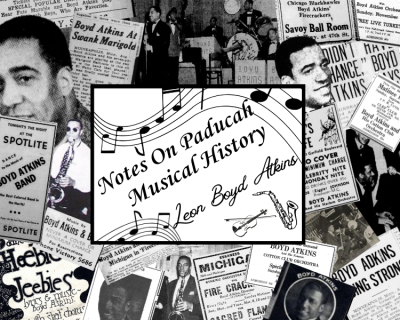
Paducah native Boyd Atkins was a musician, composer, and band leader, whose career began playing violin in the original riverboat jazz band of Fate Marable. After moving to Chicago, he performed as a member of Louis Armstrong's band at the Sunset Cafe and can be heard on the time piece, “Chicago Breakdown.” He also composed Armstrong's first hit single, “Heebie Jeebies.” Atkins built his own orchestra into one of the hottest in the country and performed for over 10,000 before a Joe Louis exhibition match. As trends in music changed, he found work in the rising blues scene of Chicago, recording with Elmore James, Magic Sam, Muddy Waters, and more. Atkins was a modest and unassuming man whose accomplishments in the world of American music during the mid 20th century have not been given the credit that they deserve.
- Nathan Lynn, Local and Family History
According to music critic Eugene Chadbourne, “In something of an epic music career, mid-west reed player Boyd Atkins went from the mainstream New Orleans jazz sound of Louis Armstrong's band to some of the hardest-edged Chicago blues, as practiced by the likes of guitar slinger Magic Sam.”1
Born on April 18, 1902, in Brookport, IL, Leon Boyd Atkins spent his youth living with his grandparents, Robert and Hester Boyd. It is believed that his mother was the couple’s daughter, Jennie Atkins, who died of consumption in 1904. The family lived at 909 North 8th St where Leon would reside through the early 1920s 2
He attended high school through his sophomore year and like his Paducah contemporary Nat Story, Akins studied under local musician Nath Bennett. He soon picked up a job on the river working alongside fellow Paducahean Fate Marable. From 1918-1921, Marable lead what some call the greatest Riverboat Jazz band to ever exist. The group defined the sound and set the bar that ensembles for years to come would strive to reach. The band consisted of Fate Marable at the piano; Baby Dodds, drums; George (Pops) Foster, bass: David Jones, mellophone; Johnny St. Cyr., banjo; Joe Howard, cornet; William Ridgely, trombone; Boyd Atkins, swing violin; Louis Armstrong, cornet. During this time Atkins was billed alongside Marable when in Paducah on the Streckfus Steamboat Line Sternwheeler Capitol, performing moonlight excursions out of Paducah and Metropolis.3
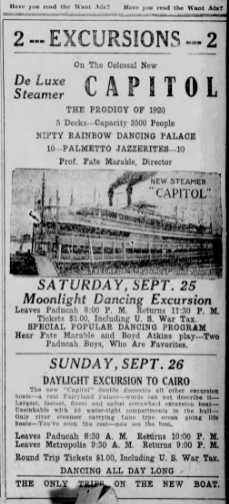
September 21, 1920 Paducah Sun reported that, “This year the ten Palmetto Jazzerites under the direction of Fate Marable, of Paducah, is the lucky orchestra to go south to outshine the crack New Orleans’ orchestra – and will render special programs of popular dance numbers on the two trips that the big excursion palace plays at Paducah. Marable is from Paducah and so is Boyd Atkins, of the orchestra.”
Also, in 1920 Atkins reportedly performed with St. Louis’ Jesse Johnson alongside Harry Dial, Sammy Long, Andrew Luper, and Jane Hemingway.4
On Thursday, May 12, 1921, the Paducah Sun Democrat reported, “SHRINE EXCURSION BIGGEST
SUCCESS OF THE SEASON: Over fifteen hundred people enjoyed the Shrine outing last night the excursion steamer Capitol, which is by far the most beautiful boat that has ever been in the local harbor. Fayette Marable, a Paducah Negro, assisted by Boyd Atkins, a Negro violinist, both formerly connected with local orchestras, has charge of the boat's orchestra and the music last night was claimed by many to be the best Paducah has heard. A large crowd gave up dancing to stand and watch the orchestra play.”5
During the early 20s, Atkins also played saxophone with the Dewey Jackson Orchestra and found work in the St. Louis music scene. The city was the home port of Streckfus, which undoubtably allowed Atkins to further his reach and development there. He would stay with Marable and the company through 1922. He soon moved to Chicago where he found new adventures with familiar friends. He performed with fellow Paducah native Ida Mae Baker (Maple), playing first sax in her group Melody Makers, formed his own band which included great players like Kid Ory, and worked with Louis Armstrong during his formative years in the city. He also performed with Louis Armstrong at the Sunset Club. In 1926, Armstrong recorded his first hit single. The song was penned by Boyd Atkins himself and entitled, “Heebie Jeebies.” It introduced the world to Armstrong and to scat singing. “Louis Armstrong and His Stompers,” set the bar at the Sunset in 1927 with players Joe Walker, Tubby Hall, Armstrong, Honore Dutrey, Al Washington, Earl Hines, Bill Wilson, Willard Hamby, Peter Briggs, Arthur Bassett and others. In May of 1927 Atkins played soprano saxophone with Armstrong’s hot seven on the track, “Chicago Breakdown.” The recording has been released numerous times and is noted as a gem of the time by critics. Hear it here: https://www.youtube.com/watch?v=HRL_OmbhQ1c 6
Atkins was a long-time member of the American Federation of Musicians and can be found mentioned in numerous engagements regarding the union at through the years.
In April of 1929, Boyd founded the Chicago Vagabonds, performing at the Savoy and working their way into a nightly gig at the Sunset. The orchestra was formed from Clarence Blacks orchestra and included the great Kid Ory. Atkins not only directed and managed the outfit, but also performed saxophone, clarinet, and violin. Critics began to take note of his leadership. Dave Peyton of the Chicago Defender noted, “They sing, they dance, and how they play. Boyd Atkins is a sensational eccentric director who looks good and knows what he’s doing.” The band performed together through 1930. 7
In 1930, Adkins was living in Chicago with his wife Carrie on South Parkway. That year he reformed his orchestra as the “Firecrackers,” debuting in February at the Michigan. The orchestra highlighted piano, banjo, and accordion. It featured Henry Prince on piano and vocals; Charles Jackson on banjo. 8
The Chicago Defender noted, “At the Sunset, Atkins and his gang were renowned as a sweet playing aggregation, but in their debut as a theater orchestra they showed a versatile ability which was entirely unexpected.”9
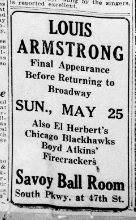
Atkins and his band were taking off like firecrackers, and on Sunday, May 25, 1930, they appeared alongside Louis Armstrong and El Herbert’s Chicago Blackhawks at the Savoy Ballroom.10
But by June, the group found themselves without employment, as the Michigan began to use canned music. They sought work elsewhere, with the 11-piece group touring West Virginia that August. The next year, 1931, the Vagabonds played nightly at Club El Rado through the summer. By August, Atkins was playing first sax in Minneapolis based Eli Rice’s Cotton Pickers. The group featured numerous players like Eddie Thompson and Joe Thomas on trumpets; Frederick (Keg) Johnson on trombone; Eddie Barifield, Bert Bailey, Bernard Wright, and Boyd Atkins, on reeds; Sylvester Rice on drums; Sanford Brady (S. Beady) on banjo; Victor Love on piano; Charles Oden on bass; Atkins as band leader; Eli Rice manager. The group played one-night gigs in Iowa, Minnesota, Nebraska, North and South Dakota that fall, meeting up with heavy hitters like Duke Ellington, Gran Moore and George Lee. They reportedly disbanded before their scheduled performing 6 nights a week at the Coliseum Ballroom through May, 1932 but could be found playing around the Midwest. 11
By the summer of 1933, the Eli Rice orchestra was back touring taking Atkins across the Midwest to North Dakota, Wisconsin, Illinois, and Iowa. The group returned to Minneapolis in January and played through May at the Eagle ballroom. The group consisted of Atkins, Milus Walker, George Derricotte on sax; Thomas Hickmann, Resnold Emmit, Ira Peddiford, Walter Bennett, on brass; Leroy Dixon, Sylvester Rice, Early Frazier, Jack Dyer, on rhythm; Eli Rice manager and director; Bertha Rice entertainer. That November, Atkins joined the Minneapolis band with Rook Ganz on trumpet; Harold Booker on piano; Walter Rouse on banjo; Adolphus Alsbrook on bass; Bill Pough on drums and vocals; Lester Young on tenor sax: and Atkins on alto sax and violin. The group could be heard nightly broadcasting on radio station WTCU.12
The Eli Rice Orchestra, along with Atkins own orchestras, worked the Cotton Club (later renamed El Paio Cafe) 106 Hyland Ave and more through 1936. By April 1, Atkins own Cotton Club Orchestra was performing nightly. The band would consist of many players over the years including Harold (Popeye) Booker on piano; Ira Pettiford, Lester Young, and Edward Lowery on trumpet; Lawrence Williams on bass; A. C. Oglesby on trombone; Spencer Smith on drums; and La Forest Dent on saxophone; Atkins on saxophone. Since the group's nightly shows were for white patrons, the band would often perform band competitions and dance offs where black music lovers would pack the house. On September 6, 1936 Atkins and his band competed against Ray Dysart’s Rhythm Kings for the best dance band in Minneapolis performing from 10 PM until sunrise.13
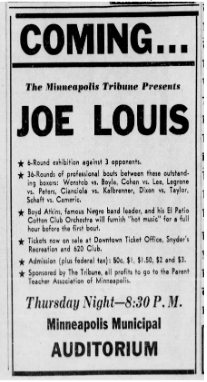
1937 started out with a “hit,” for Atkins. On January 13, Atkins and his El Patio Cotton Club Orchestra performed an hour of “hot music,” leading up to an exhibition boxing match starring the great Joe Louis in Minneapolis. The band was paid $25 for the fundraising event that drew an estimated 10,000 people. Atkins remained acquainted with the boxer and would later receive Christmas cards from Louis. 14
The band continued to perform nightly along with radio broadcasts throughout the year. Jazz critic Jack Ellis noted that the band was celebrating two years at the Cotton Club in April. Atkins was also finding work arranging music for other orchestras, and it was reported that most bands playing hotels in the Twin City area bought arrangements from him. The band also made other public appearances for Black citizens, as often segregation put up barriers to attending performances. That spring the band battled Gordon Parks Chicago Savoy Orchestra in what was billed as “...the Battle of the Century.” The event was a fundraiser and drew a lot of attention. October and November found them playing highly publicized matinee shows at the Apex Hall.15
In January 1938, Atkins band joined 10 other groups for a benefit for the Minneapolis Musicians Union. Tragedy struck the group that spring, on April 19, when bassist Lawrence Williams died. The band continued on with their weekly shows despite the loss of their good friend and band mate. In May they also performed a pickup breakfast dance for the Waiters’ Union fundraiser. The St. Paul Recorder noted, “The Cotton Club band, considered one of the tops bands in this section of the country, will make its first appearance at a public dance in several months.” That June they appeared at Riverlyn Park, St. Peter Church, and the Clef Club. In December they performed two dates at the Minn-Iowa Club. These shows all popular with black audiences. 16
1939 saw Atkins and the Cotton Club Band supporting the local musician's union again alongside the bands of Red Nichols, Don Magnus, Dick Long, Jack Malerich, Cec Hurs, Joe Billo, Hal McIntyre, Leroy Ellickson and Ken DeVillers. They were showcased as the only black band alongside, Nichols, Malerich, McIntyre, Harry Conner, Joe Plummer, Claude Ellis, Pa Trester and more at the Minneapolis Swing Concert that the Minneapolis Star called, “perhaps the finest collection of swing musicians ever assembled under one roof.” The band also performed St Patrick Day at the Clef Club and on Easter at the Minn-Iowa Club again that spring.
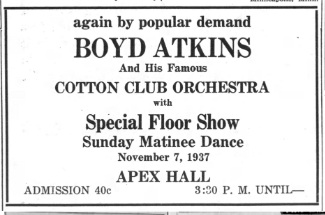
In March of 1939, the El Patio Cotton Club temporarily closed, forcing the band out after four years of steady work. Complaints of the establishment had been brought to the city council by a local citizen. Fines had been issued for staying open too late and the sale of alcohol to minors. The city council first revoked the license of the club, but two weeks later reinstated it. The band did not survive the trouble and poor publicity. At the time the band consisted of seven men, namely: La Forest Dent, tenor sax and vocalist; Leon Lewis, drums and vocalist; Harold Booker, piano; Adolphus Alsbrook, bass: Andre Ogelsby, trombone; Ira Pettiord, trumpet and specialties; Boyd Atkins, saxophone, and arranger. Their time at the club band define the Minneapolis music scene, hosting countless musicians and performers that played the Twin Cities. The Pittsburg Courier reported the band was, “ousted because of a color bar.” 17
Akins noted that he and his band never had a chance. “The patrons didn't dislike the band. In fact, they were crazy about it. We had worked there three years and had a tremendous following. Mr. Washington, of the Urban League, and I, investigated and found out that the pressure was from a woman’s club. Negroes are not permitted to live in the village, which is a suburb of Minneapolis, so we did not have a chance.”18
The St. Paul Recorder reported that the local Mill City Musicians Union that Atkins had been so dedicated to, double crossed him regarding the bands work at the El Patio Cotton Club.19
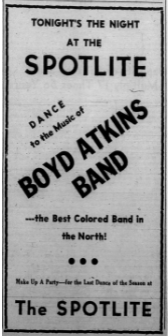
The band wasted no time and got to work. They performed at the Knights of Pythias Anniversary Ball, Knickerbocker Hall, numerous dates at the Minn-Iowa Club, Mardi Gras at Norway Hall, Wednesdays and Sundays at the Marigold Ballroom, Moran’s, 4th of July at Riverlyn Inn (alongside Alma Smith), the Pines, Spotlite, and numerous other engagements. At the Marigold, they became the first black house band in the last 10 years, marking the first summer the venue had remained open for the season. The band also hosted a, “Jim Jam Jive Session,” at the Clef Club that August, which featured the best musicians in the Twin Cities at the time. The group played the Spotlite through the fall, when Atkins began to shift his home base back to Chicago. 20
His Paducah roots and time on the river continued to flow through his life. In the summer of ‘39, Atkins' longtime friend Louis Armstrong played in Minneapolis to nearly 3000 people. While in town, he was the guest of the Atkins where they reminisced about their times as younger men at the Sunset and working the river circuit with Marable.21
In early 1940, Boyd and Carrie moved back to Chicago. Newspaper reports noted that at first the couple wished to be back in Minnesota. Within a month of relocating, while he had found steady work, his car was broken into on several occasions, and he had been robbed at gunpoint. The 1940 census shows him and Carrie living at 6026 South Michigan Ave. Boyd found work, playing at the Savoy Ballroom with Dr. Jive Cadillac and his 2-Tone Band, which included Rhythm Willie, Monett Moore, and Roy Slaughter. In September, Boyd Atkins & His Harlem Orchestra picked up a 7-month stint at Dave’s Cafe, 343 Garfield Blvd, supporting Joe “Ziggie” Johnson. In a nationwide contest for the most popular jazz band, the Chicago Defender reported Atkins finished 16th. On December 28th he appeared with Fats Waller, Les Hite, and others to honor the winner, Count Baise. By this time Atkins was somewhat of a celebrity in Chicago and the Jazz world. 22
January 1941 found Atkins sick with the flu. Upon recovering, he and his band continued their shows at Dave’s and at the Swingland Cafe that winter. On April 10, the band played their last show at Daves, with Coleman Hawkins taking over the slot. Following his success at Daves, Atkins played shows in the Midwest with a band consisting of Nat Walker, Rip Bassett, Buddy Smith, Julian Draper, Nathaniel Atkins, Paul King and Al Cobb. In August they settled back into Chicago’s south side for a stay at the Club Plantation performing four shows a night. 23
After nearly 7 months as the house band at the club, Atkins and his band moved to the Paddock Club in February 1942. That same month he registered for the draft but never saw service. He and his band were on the move that year playing across the mid-west from Cedar-Rapids to Peoria. In Peoria, he found a new home and would be featured at the Faust Club for over 4 years. His band at the time consisted of Otho Allen on drums; Edith Clark on piano; Agnew Gary on trumpet; and Atkins on Saxophone. 24
Not much is known about Atkins during his stay in Peoria up through 1950. The 1950 census shows him and Carrie living at 6411 Maryland Ave and working as a rooming house operator. As always, he stayed involved with the local musicians’ union and still could be found performing, but the early 50’s saw a shift for Atkins to the rising blues scene in Chicago. With the great migration of Mississippi blues artist to Chicago, Atkins found new life in the city's changing musical landscape. In December 1952 he was advertised performing with blues and boogie woogie artist Jack Cooley at the Harmonia Lounge. He also joined the Sunnyland Slim combo along with Big Crawford and Rudy Pernell that month at the famous 708 Club, alongside Muddy Waters and Elmore James. The group would later use John Henry, Alfred Wallace performing through 1953. But Atkins found work with Slim, Waters, and Elmore. He performed as part of James group the “Broom Dusters,” on and off in the 50s at joints like Silvio's. 25
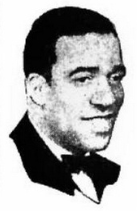
In August of 1953 he recorded tenor sax on the James recording, "Dark and Dreary,” “Make My Dreams Come True,” and “Strange Kinda Feelin,’” in Chicago. Some speculate its Atkins and J. T. Brown on saxophones on James, release, “The Sky is Cryin,” “Strange Kinda Feeling,” and other early James recordings.26
Music critic, Eugene Chadbourne, noted, “He is also one of the reverb-drenched saxophonists who strived to stay in tune with wild slide guitarist Elmore James, not that anyone wanted them to. 27
During this time period, Atkins recorded on Muddy Waters tracks, “Real Love,” “Lonesome Bedroom Blues,” and “Messin' With The Man,” at Chess Records in in the 1950s and with Lee Jackson on “Pleadin’ For Love,” and “Jaunita,” in 1960.28
He can also be found on the Magic Sam tracks, “Every Night About This Time,” “Blue Light Boogie,” “You Don't Have to Work,” “My Love is Your Love,” “Mr. Charlie,” “Square Dance Rock pt 1.” and “Square Dance Rock Pt 2.”29
Not much is written about the last years of Atkins life. It appears that Atkins spent his later years managing his home property at 6411 South Maryland street in between gigs.30
Adkins died from complications of a heart attack on March 1, 1965 in Chicago. He was buried in Saint Mary Catholic Cemetery and Mausoleum in Evergreen Park, IL. While for years he had been a topic within the musical writings of newspapers, no mention of his death could be found in newspapers at the time of this research. 31
To learn more about Atkins and other Jackson Purchase musicians, please visit us in the Local and Family History Room at the McCracken County Public Library.
- Nathan Lynn
Footnotes:
1 "Twin Town Talk” The St. Paul Recorder, Dec 23, 1938, Vol. 5 No. 19 edition. https://www.newspapers.com/image/884875180/?match=1&terms=%22Boyd%20Atkins%22
Chadbourne, Eugene. “AllMusic Is Being Updated.: Music Search, Recommendations, Videos and Reviews.” AllMusic. Accessed February 28, 2025. https://www.allmusic.com/artist/boyd-atkins-mn0000080375#biography.
2 National Archives at St. Louis; St. Louis, Missouri; Wwii Draft Registration Cards For Illinois, 10/16/1940-03/31/1947; Record Group: Records of the Selective Service System, 147; Box: 52. Source Information: Ancestry.com. U.S., World War II Draft Cards Young Men, 1940-1947 [database on-line]. Lehi, UT, USA: Ancestry.com Operations, Inc., 2011. Year: 1910; Census Place: Paducah Ward 1, McCracken, Kentucky; Roll: T624_493; Page: 9b; Enumeration District: 0125; FHL microfilm: 1374506, Ancestry.com. 1910 United States Federal Census [database on-line]. Lehi, UT, USA: Ancestry.com Operations Inc, 2006.Original data: Thirteenth Census of the United States, 1910 (NARA microfilm publication T624, 1,178 rolls). Records of the Bureau of the Census, Record Group 29. National Archives, Washington, D.C. For details on the contents of the film numbers, visit the following NARA web page: NARA. Accessed August 24, 2025.
Year: 1880; Census Place: Paducah, McCracken, Kentucky; Roll: 430; Page: 93d; Enumeration District: 123. Source Information: Ancestry.com and The Church of Jesus Christ of Latter-day Saints. 1880 United States Federal Census [database on-line]. Lehi, UT, USA: Ancestry.com Operations Inc, 2010. 1880 U.S. Census Index provided by The Church of Jesus Christ of Latter-day Saints © Copyright 1999 Intellectual Reserve, Inc. All rights reserved. All use is subject to the limited use license and other terms and conditions applicable to this site.Original data: Tenth Census of the United States, 1880. (NARA microfilm publication T9, 1,454 rolls). Records of the Bureau of the Census, Record Group 29. National Archives, Washington, D.C. Accessed August 24, 2025
“Home.” City of Paducah. Accessed August 24, 2025. https://www.paducahky.gov/departments/parks-recreation/oak-grove-cemetery.
Watkins Funeral Home Ledgers. Vol. Book 10. pg. 349 vols. Accessed August 24, 2025. https://digitalcollections.mclib.net/luna/servlet/media/book/showAllPagesThumbnail?mid=McCracken~31~31~10~3947.
1910 U.S. Census notes living with his Grandfather Robert Boyd on North 8th St.
1916 Paducah city directory student boarding at 909 Nort 8th
1918 Paducah city directory musician boarding at 909 Nort 8th
1920 Paducah city directory musician boarding at 909 Nort 8th
3Year: 1940; Census Place: Chicago, Cook, Illinois; Roll: m-t0627-00931; Page: 61B; Enumeration District: 103-321. Source Information: Ancestry.com. 1940 United States Federal Census [database on-line]. Provo, UT, USA: Ancestry.com Operations, Inc., 2012. Original data: United States of America, Bureau of the Census. Sixteenth Census of the United States, 1940. Washington, D.C.: National Archives and Records Administration, 1940. T627, 4,643 rolls.
Hoffman, Mary M. “Self-Taught Negro Musician Dies at 84.” The Paducah Sun. March 17, 1957, Vol. 80, No. 65 edition. https://www.newspapers.com/image/428955225/?match=1&terms=Nath%20Bennett.
Williams, Dolores Meyer, and Missouri Historical Society. “Satchmo On The River.” St. Louis Post-Dispatch, July 12, 1971, Vol. 93, No. 190 edition. https://www.newspapers.com/image/140163594/.
4 Kenney, William Howland. Jazz on the River. Chicago, IL: University of Chicago Press, 2013. Pg. 103
5“SHRINE EXCURSION BIGGEST SUCCESS OF THE SEASON.” The Paducah Sun . May 13, 1921, Vol. 52 edition, sec. No. 114. https://www.newspapers.com/image/502184695/.
6“Atkins, Boyd.” Notable Kentucky African Americans Database. University of Kentucky , December 20, 2020. https://nkaa.uky.edu/nkaa/items/show/1844.
“Records ‘Heebie Jeebies.’” The Black Dispatch, May 06, 1926, Vol. 11, No. 24 edition. https://www.newspapers.com/image/872012116/?match=1&terms=%22Boyd%20Atkins%22 .
Barron, Mark. “Record Sales Now Swinging To New Highs.” The Times-Picayuna, Oct. 18, 1940, Vol. 104 No. 268 edition. https://www.newspapers.com/image/1249643455/?match=1&terms=%22Boyd%20Atkins%22 .
Mabbott, Lucille. “Adventures In Music.” Rapid City Journal, June 24, 1951, No. 21208 edition. https://www.newspapers.com/image/351296978/.
Rink, Janet. “Satchmo Comes Home.” The Times-Picayune, Oct 31, 1965, Vol. 129 No. 280 edition. https://www.newspapers.com/image/1251380747/ .
7 “Chicago Vagabonds.” The Chicago Defender, Apr 13, 1929, Vol. 24, No. 50 edition. https://www.newspapers.com/image/1135954851/?match=1&clipping_id=new .
“Chicago Vagabonds.” The Chicago Defender, May 4, 1929, Vol. 25, No. 1 edition. https://www.newspapers.com/image/1135955333/?match=1&terms=%22Boyd%20Atkins%22
Yanow, Scott. “Kid Ory: Profiles in Jazz.” The Syncopated Times, June 27, 2020. https://syncopatedtimes.com/profiles-in-jazz-kid-ory/.
Peyton, Dave, “The Musical Bunch.” The Chicago Defender, June 15, 1929, Vol. 25, No. 7 edition. https://www.newspapers.com/image/1135956335/?match=1&terms=%22Boyd%20Atkins%22
rs.com/image/1135955333/?match=1&terms=%22Boyd%20Atkins%22
Barnes Jr, Walter, “The Musical Bunch.” The Chicago Defender, Nov 2, 1929, Vol. 25, No. 7 edition. https://www.newspapers.com/image/1135858652/?match=1&terms=%22Boyd%20Atkins%22
8 Year: 1930; Census Place: Chicago, Cook, Illinois; Page: 21B; Enumeration District: 0109; FHL microfilm: 2340154
“Boyd Atkins and Band...” The Chicago Defender, Feb 22, 1929, Vol. 25, No. 23 edition. https://www.newspapers.com/image/1136302001/?match=1&terms=%22Boyd%20Atkins%22
“Boyd Atkins and His Band...” The Chicago Defender, March 1, 1930, Vol. 25, No. 44 edition. https://www.newspapers.com/image/1136302351/?match=1&clipping_id=new
“’Hell’s Heroes’ and...” The Chicago Defender, Apr 19, 1930, Vol. 25, No. 51 edition. https://www.newspapers.com/image/1138026228/?match=1&clipping_id=new
9 “Boyd Atkins and His Band...”
10 “Louis Armstrong Final...” The Chicago Defender, May 24, 1930, Vol. 26, No. 4 edition. https://www.newspapers.com/image/1138031501/?match=1
11 “The Musical Bunch.” The Chicago Defender, June 7, 1930, Vol. 26, No. 6 edition. https://www.newspapers.com/image/1138033277/?match=1&terms=%22Boyd%20Atkins%22
“News Among the Colored People.” Hinton Daily News, Aug 27, 1930, Vol. 28, No. 96 edition. https://www.newspapers.com/image/667551441/?match=1&clipping_id=new
Hayes, Bob, “Here and There....” Chicago Defender, Feb 14, 1931, Vol. 26, No. 42 edition. https://www.newspapers.com/image/1135719369/?match=1&terms=%22Boyd%20Atkins%22
"With the Jazz Orchestras,” The St. Louis Argus, May 1, 1931, Vol. 20, No. 2 edition. https://www.newspapers.com/image/957201661/?match=1&terms=%22Boyd%20Atkins%22
Barnes, Walter, “Hittin’ the High Notes.” The Chicago Defender, Oct 7, 1931, Vol. 27, No. 23 edition. https://www.newspapers.com/image/1140870615/?match=1&terms=%22Boyd%20Atkins%22
Barnes, Walter, “Hittin’ the High Notes.” The Chicago Defender, Dec 26, 1931, Vol. 27, No. 35 edition. https://www.newspapers.com/image/1135753231/?match=1&terms=%22Boyd%20Atkins%22
Barnes, Walter, “Hittin’ the High Notes.” The Chicago Defender, Nov 14, 1931, Vol. 27, No. 29 edition. https://www.newspapers.com/image/1141668999/?match=1&terms=%22Boyd%20Atkins%22
12 Ellis, Jack, “The Orchestras” Chicago Defender, June 24, 1933, Vol. 29, No. 9 edition. https://www.newspapers.com/image/1135710037/?match=1&terms=%22Boyd%20Atkins%22
Ellis, Jack, “The Orchestras” Chicago Defender, Jan 20, 1934, Vol. 29, No. 39 edition. https://www.newspapers.com/image/1136309210/?match=1&terms=%22Boyd%20Atkins%22
“Boyd Atkins Has Band....” Chicago Defender, Nov 10, 1934, Vol. 30, No. 28 edition. https://www.newspapers.com/image/1136113906/?match=1
13 “Minneapolis Sunday Forum.” St. Paul Recorder, Apr 3, 1936, Vol. 2, No. 34 edition. https://www.newspapers.com/image/884016594/?match=1&terms=%22Boyd%20Atkins%22
“Boyd Adkins Going Strong” Chicago Defender, Apr 25, 1936, Vol. 31, No. 52 edition. https://www.newspapers.com/image/1135708874/?match=1&clipping_id=new
“To Settle Best Local Band Question” St. Paul Recorder, September 4, 1936, Vol. 3, No. 4 edition. https://www.newspapers.com/image/884017968/?match=1&terms=%22Boyd%20Atkins%22
Ellis, Jack, “The Orchestras” Chicago Defender, Dec 5, 1936, Vol. 32, No. 32 edition. https://www.newspapers.com/image/1143021978/
“Boyd Atkins’ Band to Play Matinee Dance” The St. Paul Recorder, Dec, 1938, Vol. 5, No. 20 edition. https://www.newspapers.com/image/884212075/?match=1&terms=%22Boyd%20Atkins%22
14 “Tomorrow Night The Minneapolis Tribune Presents Joe Louis.” The Minneapolis Tribune. January 13, 1937, 234 edition. https://www.newspapers.com/image/182954842/.
"Bomber Needs Aid of Police...” The Minneapolis Tribune, January 14, 1937, Vol. 17 No. 235 edition. https://www.newspapers.com/image/182955265/?match=1&terms=%22Boyd%20Atkins%22
"Tribune Gives P.T.A....” The Minneapolis Tribune, January 19, 1937, Vol. 17 No. 240 edition. https://www.newspapers.com/image/182957240/?match=1&terms=%22Boyd%20Atkins%22
"Twin Town Talk”
15 Ellis, Jack, “The Orchestras” Chicago Defender, April 10, 1937, Vol. 37, No. 50 edition. https://www.newspapers.com/image/1135917847/?match=1&terms=%22Boyd%20Atkins%22
“Twin Town Talk.” The St. Paul Recorder. February 19, 1937, Vol. 3 No. 27 edition. https://www.newspapers.com/image/884209173/?match=1&clipping_id=new
“Jimmy Slemmons of the ...” The St. Paul Recorder. May 7, 1937, Vol. 3 No. 38 edition. https://www.newspapers.com/image/884852565/?match=1&terms=%22Boyd%20Atkins%22
“Boyd Atkins and His Famous ...” The St. Paul Recorder. Nov 5 1937, Vol. 4 No. 12 edition. https://www.newspapers.com/image/884853003/?match=1&clipping_id=new
Twin Town Talk, Dec. 23, 1938
16 “11 Bands for Dance” The Minneapolis Tribune. January 18, 1938, Vol. 71 No. 239 edition. https://www.newspapers.com/image/182767850/?match=1&terms=%22Boyd%20Atkins%22
“Lawrence Williams, Musician, Dies...” St. Paul Recorder. April 22, 1938, Vol. 4 No. 36 edition. https://www.newspapers.com/image/884871995/?match=1&terms=%22Boyd%20Atkins%22
“Two Orchestras Feature...” St. Paul Recorder. May 20, 1938, Vol. 4 No. 40 edition. https://www.newspapers.com/image/884211703/?match=1&terms=%22Boyd%20Atkins%22
“Picnic Sunday at Riverlyn.” St. Paul Recorder. Jun 10, 1938, Vol. 4 No. 43 edition. https://www.newspapers.com/image/884211740/?match=1&terms=%22Boyd%20Atkins%22
“Men to Rule at...” St. Paul Recorder. July 22, 1938, Vol. 4 No. 49 edition. https://www.newspapers.com/image/884211844/?match=1&terms=%22Boyd%20Atkins%22
“Twin City Entertainers Matinee...” St. Paul Recorder. Sep 16, 1938, Vol. 5 No. 5 edition. https://www.newspapers.com/image/884211967/?match=1&clipping_id=new
“Boyd Atkins’ Band to Play...”
17 “Musicians Finish Benefit...” The Minneapolis Tribune. Jan 7, 1939, Vol. 35 No. 122 edition. https://www.newspapers.com/image/178662006/?match=1&terms=%22Boyd%20Atkins%22
“Everything’s Set for...” The Minneapolis Tribune. Jan 21, 1939, Vol. 35 No. 134 edition. https://www.newspapers.com/image/178757263/?match=1&clipping_id=new
“Boyd Atkins” The St. Paul Recorder. Mar 17, 1939, Vol. 5 No. 31 edition. https://www.newspapers.com/image/884212148/?match=1&clipping_id=new
“Boyd Atkins” The St. Paul Recorder. Mar 24, 1939, Vol. 5 No. 32 edition. https://www.newspapers.com/image/884212148/?match=1&clipping_id=new
Kellum, David, “Backstage with the Score.” The Chicago Defender, Mar 25, 1939, Vol. 34, No. 48 edition. https://www.newspapers.com/image/1135654881/?match=1&clipping_id=new
“Boyd Atkins at Swank Marigold.” The New Pittsburgh Courier. Aug 26, 1939, Vol. 30 No. 34 edition. https://www.newspapers.com/image/39548757/?match=1&terms=%22Boyd%20Atkins%22
“El Patio to Bunny’s.” St Louis Park Historical Society. Accessed November 5, 2025. https://slphistory.org/eb5916/.
18 “’Didn’t Have Chance’” The New Pittsburgh Courier, Jun 3, 1939, Vol. 30, No. 22 edition. https://www.newspapers.com/image/1138129745/?match=1&terms=%22Boyd%20Atkins%22
19 “Twin Town Talk” The St. Paul Recorder. May 6, 1939, Vol. 5 No. 38 edition. https://www.newspapers.com/image/884874727/?match=1&clipping_id=new
20 “The Hermoin lodge...” The Minneapolis Sunday Tribune. Apr 9, 1939, Vol. 72 No. 320 edition. https://www.newspapers.com/image/180288042/?match=1&clipping_id=new
“Swing Club Jamboree” The St. Paul Recorder. Apr 14, 1939, Vol. 5 No. 35 edition. https://www.newspapers.com/image/884212207/?match=1&terms=%22Boyd%20Atkins%22
“Inquisitive Sal” The St. Paul Recorder. Apr 14, 1939, Vol. 5 No. 35 edition. https://www.newspapers.com/image/884212220/?match=1&terms=%22Boyd%20Atkins%22
“Twin Town Talk” The St. Paul Recorder. Apr 28, 1939, Vol. 5 No. 37 edition. https://www.newspapers.com/image/884212220/?match=1&terms=%22Boyd%20Atkins%22
“Dance Tonight..” The Minneapolis Star Tribune. Apr 30, 1939, Vol. 72 No. 341 edition. https://www.newspapers.com/image/180321596/?match=1&terms=%22Boyd%20Atkins%22
“Dance Moran's Sat..” The Brainerd Dispatch. May 11, 1939, Vol. 65 No. 238 edition. https://www.newspapers.com/image/1223145225/?match=1&terms=%22Boyd%20Atkins%22
“Modern Dance...” The Eau Claire Leader. June 7, 1939, Vol. 58 No. 131 edition. https://www.newspapers.com/image/884212275/?match=1&terms=%22Boyd%20Atkins%22
“Here It Is...” The St. Paul Recorder. May 19, 1939, Vol. 5 No. 40 edition. https://www.newspapers.com/image/272576655/?match=1&terms=%22Boyd%20Atkins%22
“Atkins Band in Jam Session....” The Minneapolis Spokesman, Aug 25, 1939, Vol. 6 No. 2 edition. https://www.newspapers.com/image/884212444/?match=1&terms=%22Boyd%20Atkins%22
“Boyd Atkins at Swank Marigold.”
“Dance Tonite Al..” The Brainerd Dispatch. Sep 9, 1939, Vol. 66 No. 32 edition. https://www.newspapers.com/image/1221019492/?match=1&terms=%22Boyd%20Atkins%22
21 ”Boyd Atkins At Swank Marigold”
22 “Twin Town Talk.” St Paul Recorder, May 17, 1940, Vol. 6, No. 40 edition. https://www.newspapers.com/image/884212876/?match=1&terms=%22Boyd%20Atkins%22.
“Aviation Ball And Dance.” The Chicago Defender, Aug 10, 1940, Vol. 36, No. 16 edition. https://www.newspapers.com/image/1135702676/ .
“Boyd Atkins Open For Engagements.” The Chicago Defender, Apr 05, 1941, Vol. 36, No. 50 edition. https://www.newspapers.com/image/1142442579/?match=1&terms=%22Boyd%20Atkins%22 .
“Open Saturday... Dave’s Cafe.” The Chicago Defender, Aug 10, 1940, Vol. 36, No. 19 edition. https://www.newspapers.com/image/1135702870/.
“Five Big Name Bands...” The Chicago Defender, Dec 21, 1940, Vol. 36, No. 35 edition. https://www.newspapers.com/image/1136151203/?match=1 .
“Five Big Name Bands...” The Chicago Defender, Dec 21, 1940, Vol. 36, No. 35 edition. https://www.newspapers.com/image/1142439605/?match=1&terms=%22Boyd%20Atkins%22.
“Here’s How The Bands Finished Popularity Race.” The Chicago Defender, Dec 7, 1940, Vol. 36, No. 33 edition. https://www.newspapers.com/image/1142336127/ .
23 Monroe, Al. “Swingin’ The News” The Chicago Defender, Jan 18, 1911, Vol. 36 No. 39 edition. https://www.newspapers.com/image/1142439923/?match=1&terms=%22Boyd%20Atkins%22 .
Nosey, Ole. “Everybody Goes When the Wagon Comes” The Chicago Defender, Feb 15, 1941, Vol. 36 No. 43 edition. https://www.newspapers.com/image/1135655386/ .
“Boyd Atkins Open For Engagements.”
Nosey, Ole. “Everybody Goes When the Wagon Comes” The Chicago Defender, Apr 12, 1941, Vol. 36 No. 51 edition. https://www.newspapers.com/image/1135655586/?match=1&terms=%22Boyd%20Atkins%22
Monroe, Al. “Swingin’ The News” The Chicago Defender, June 14, 1941, Vol. 37 No. 8 edition. https://www.newspapers.com/image/1135655814/?match=1&terms=%22Boyd%20Atkins%22 .
"Opens To-Nite...” The Chicago Defender, Aug 16, 1941, Vol. 37 No. 17 edition. https://www.newspapers.com/image/1142559655/?match=1&terms=%22Boyd%20Atkins%22
"Boyd Atkins and his...” Suburbanite Economist, Aug 27, 1941, Vol. 40 No. 53 edition. https://www.newspapers.com/image/54381319/?match=1&terms=%22Boyd%20Atkins%22
24 The Foxhead... The Gazette, Cedar Rapids, Mar 22, 1942 https://www.newspapers.com/image/549434307/?match=1&terms=%22Boyd%20Atkins%22
"Swingin’ the News,” The Chicago Defender, Apr 2, 1942, https://www.newspapers.com/image/1135888989/?match=1&terms=%22Boyd%20Atkins%22
"Boyd Atkins in Peoria,” New Pittsburg Courier, Aug 15, 1942, https://www.newspapers.com/image/40809828/?match=1&terms=%22Boyd%20Atkins%22
Nosey, Ole, "Everybody Goes When the Wagon Comes,” The Chicago Defender, Jul 22, 1944,
https://www.newspapers.com/image/1138920399/?match=1&terms=%22Boyd%20Atkins%22
“Boyd Atkins in Downstate...,” The Chicago Defender, Jul 28, 1945, Vol. 31 No. 50
https://www.newspapers.com/image/1135870862/?match=1&terms=%20Otho%20Allen%20Edith%20Clark%20
25 "Musicians Union, Local 208...,” The Chicago Defender, Dec 17, 1949,
https://www.newspapers.com/image/1138163177/?match=1&terms=%22Boyd%20Atkins%22
National Archives at Washington, DC; Washington, D.C.; Seventeenth Census of the United States, 1950; Year: 1950; Census Place: Chicago, Cook, Illinois; Roll: 516; Page: 20; Enumeration District: 103-715
"What the cats...,” The Chicago Defender, Dec 13, 1952, Vol. 38 No. 36
https://www.newspapers.com/image/1139113523/?match=1&clipping_id=new
"What the cats...,” The Chicago Defender, Dec 13, 1952, Vol. 38 No. 36
https://www.newspapers.com/image/1139113523/?match=1&clipping_id=new
"What the cats...,” The Chicago Defender, May 9, 1953, Vol. 49 No. 5
https://www.newspapers.com/image/1139113523/?match=1&clipping_id=new
"Don't Miss This Treat...,” The Chicago Defender, Dec 16, 1952,
https://www.newspapers.com/image/1139113523/?match=1&clipping_id=new
26 Elmore James and the broom dusters - blues after hours. DiscCogs. (n.d.-a). https://www.discogs.com/release/808037-Elmore-James-And-The-Broom-Dusters-Blues-After-Hours
Johnny Jones - Doin’ the best I can. DiscCogs. (n.d.-b). https://www.discogs.com/release/13771211-Johnny-Jones-Doin-The-Best-I-Can
27 Chadbourne, Eugene. “AllMusic Is Being Updated.: Music Search, Recommendations, Videos and Reviews.” AllMusic. Accessed February 28, 2025. https://www.allmusic.com/artist/boyd-atkins-mn0000080375#biography.
28 Muddy Waters - You shook me - the chess masters, vol. 3, 1958 to 1963. DiscCogs. (n.d.-f). https://www.discogs.com/release/5733180-Muddy-Waters-You-Shook-Me-The-Chess-Masters-Vol-3-1958-To-1963
Various - chicago blues session volume 2. DiscCogs. (n.d.-h). https://www.discogs.com/release/8796435-Various-Chicago-Blues-Session-Volume-2
29 Magic Sam - West Side Guitar 1957-1966. DiscCogs. (n.d.-b). https://www.discogs.com/release/7661907-Magic-Sam-West-Side-Guitar-1957-1966
30 National Archives at Washington, DC; Washington, D.C.; Seventeenth Census of the United States, 1950; Year: 1950; Census Place: Chicago, Cook, Illinois; Roll: 516; Page: 20; Enumeration District: 103-715. Source Information: Ancestry.com. 1950 United States Federal Census [database on-line]. Lehi, UT, USA: Ancestry.com Operations, Inc., 2022. Original data: Department of Commerce. Bureau of the Census. 1913-1/1/1972. Population Schedules for the 1950 Census, 1950 - 1950. Washington, DC: National Archives at Washington, DC. Population Schedules for the 1950 Census, 1950 - 1950. NAID: 43290879. Records of the Bureau of the Census, 1790 - 2007, Record Group 29. National Archives at Washington, DC., Washington, DC.
31 "Cook, Illinois, United States records," images, FamilySearch (https://www.familysearch.org/ark:/61903/3:1:3Q9M-C9B7-B3JH-J?view=explore : Nov 18, 2025), image 1345 of 4867; Cook County (Illinois). County Clerk. Image Group Number: 101276775