
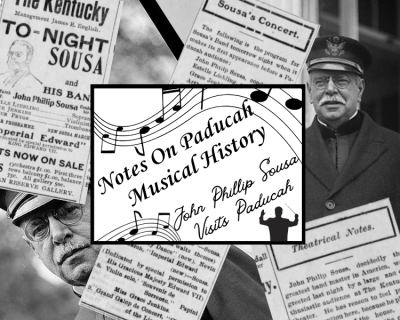
This weekend marks the start of the Paducah Symphony Orchestra's 46th season, as well as Maestro Rafaelle Ponti’s very first “Behind the Notes” program at your McCracken County Public Library. In recognition, we look back to classical Paducah, more than 120 years ago, when beloved American composer and conductor John Philip Sousa came to town.
Sousa was a prolific composer, having written several suites, operettas, humoresques, fantasies, overtures, and countless other tunes. However, he is best known for his marches, and in his lifetime, wrote more than 130 of them. I daresay most Americans would recognize his work, having heard them at fireworks shows and military parades. Even if you don’t recognize his most famous compositions by name (Stars and Stripes Forever, Semper Fidelis, The Washington Post, The Thunderer), a quick listen on Youtube will have you saying, “Oh yeah...I’ve heard that before.”
Can you hear the theme of Monty Python’s Flying Circus in your head? That happens to be a Sousa march entitled The Liberty Bell.
Ever heard of the instrument the sousaphone? It’s named after John Philip Sousa who helped to develop it.
How about the novella “The Fifth String” about a violinist who makes a deal with the devil? Okay...you probably haven’t heard of that one; it’s relatively obscure. But Sousa wrote it!
Sousa conducted the Marine Band for five different presidents (from Hayes to Harrison) after which he started his own civilian band and began touring the country. On November 18, 1902, his tour brought him to the Kentucky Theater in Paducah, a program which not only featured Sousa conducting two new pieces of his own (the Looking Upward Suite and the Imperial Edward March), but also featured Metropolitan Opera star and renowned soprano, Estelle Liebling, and legendary trombonist Arthur Pryor. You can find the complete program for the performance attached.
Sousa and his band played to a sellout crowd, and while the $1 orchestra ticket may sound cheap to us, it was the equivalent to about $33 in today’s money. However, if the reviewer from the Paducah Sun is to be believed, the performance left a little to be desired. The review (also attached) contains several backhanded compliments: Sousa himself “gave satisfaction” to the audience but possessed “extreme modesty” and a “lack of gymnastic contortions” (unlike PSO’s delightfully animated maestro); Liebling, the soprano, was tonally pure but lacked “warmth” and “expression”; and guest violinist Grace Jenkins was “pleasing but not impressive.”
The reviewer was even critical of the audience recalling Paducah’s tendency to clap in the wrong places, occurrences which seemed to embarrass the reviewer who wrote, “Mr. Sousa seemed pleased with his audience, and it is hoped he didn’t think Paducah people know little about music.”
Apparently, Sousa was fine with the crowd because he came back to Paducah at least twice more before his death in 1932.
The program for the 1902 performance, an ad for the performance, and the full review, were clipped from the historic issues of the Paducah Sun. For more about musicality in Paducah, please visit the Local and Family History room at your McCracken County Public Library, and for you classical music lovers, be sure to check out Maestro Ponti’s talk, “Behind the Notes,” at the library this Saturday at 10 AM.