Banned Books Week was launched in 1982 in response to a sudden surge in the number of challenges to books in libraries, bookstores, and schools. Held in the last week of September or first week of October, the annual event highlights the value of free and open access to information and brings together the entire book community — librarians, educators, authors, publishers, booksellers, and readers of all types — in shared support of the freedom to seek and to express ideas. The American Library Association and Banned Books Week Coalition chose the theme for Banned Books Week 2025: “Censorship Is So 1984. Read for Your Rights.” With the escalation in attempts to ban books in libraries, schools, and bookstores around the country, George Orwell’s cautionary tale "1984" serves a prescient warning about the dangers of censorship. This year’s theme reminds us that the right to read belongs to all of us, that censorship has no place in contemporary society, and that we must defend our rights.
Library staff were challenged to read and review a book that has been banned before and report back.
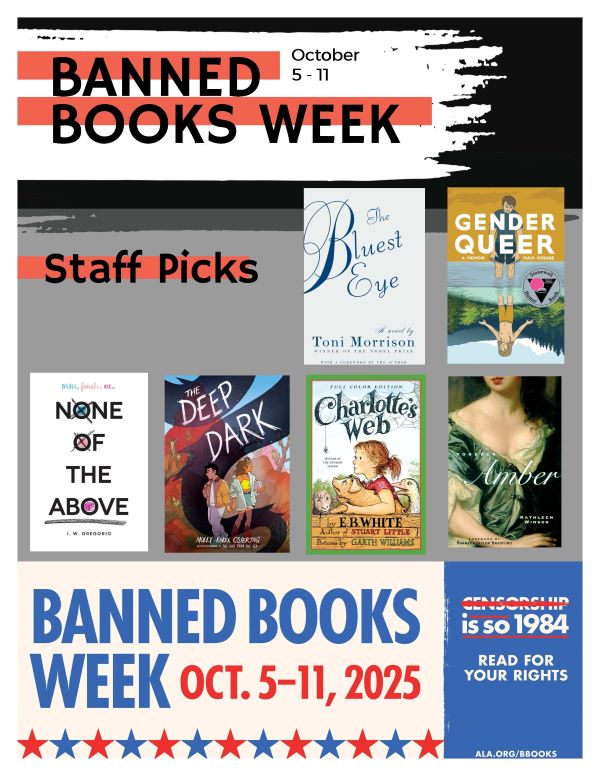
Our staff picks for this week:
The Bluest Eye by Toni Morrison
The Bluest Eye was published over 55 years ago. The book's protagonist, 11-year-old Pecola Breedlove, is a social outcast, and is vulnerable to harsh realities of her background. She dreams of having blue eyes like the movie star Shirley Temple. In her innocence she feels if she had blue eyes -she would be free ! She would be free from judgement, rejection, racism, heartbreak & poverty. She equates physical appearance with self-worth.
As a reader we can empathize with a young girl caught up in a world of prejudice and abuse. We acknowledge the effect of family and community in shaping identities whether nurturing or damaging. The impact of her rape by her father leaves her powerless contributing to her final breakdown. The novel confronts the ramification of incest and child sexual abuse. A painful read but a beautifully impacting novel still relevant today. -Bobbie
I read this book many, many years ago, and let me tell you, it sure hits different reading it as an adult. Long story short, a little girl named Fern becomes attached to a tiny little pig named Wilbur, who is the runt of his litter, born at their farm. As Wilbur grows into an adult pig, he is rehomed to Fern's uncle's farm, where he meets new animal friends, notably, a spider named Charlotte, who comes to Wilbur's rescue from being slaughtered. Charlotte writes out messages such as, "some pig" and "radiant" in her web, praising Wilbur as he shows off by turning flips, in hopes that Fern's uncle, Mr. Zuckerman, will be impressed and decide to keep Wilbur. The real star of the show is sweet and gentle Charlotte, with her web-weaving skills. When Charlotte grows older and doesn't have much life left, she asks Wilbur and her other animal friends to care for her spider babies in the egg sack, so they may carry on her legacy. As a child, and to this day, I got teary-eyed during this part of the story. As an adult, I respect the friendships and love that Wilbur, Charlotte, and the other animals all have for one another. Charlotte spared Wilbur from a certain death, just as Wilbur saved Charlotte's egg sack from being destroyed, so that 3 of her babies may thrive. This book was challenged because of the topic of death, and the cycle of life. Talking animals with human-like traits was also another reason. I loved this book when I was little, and appreciate it even more now, re-reading it as an adult. -Amanda
Deep Dark by Moly Knox Ostertag
This graphic novel is so beautiful. I loved the artwork. I checked it out (via Hoopla) because I had read and enjoyed Ostertag’s middle grades graphic novel The Girl from the Sea when I was still working in the Youth department. Deep Dark falls solidly in the Young Adult or New Adult category and is so beautifully written and illustrated. The story involves a deep dark secret, in physical form that is kept in the basement. This is clearly an allegory about dealing with a secret shame from trauma in the past that is with Mags all of the time. Mags and Nessa are beautiful characters. I wanted so bad to know what trauma the monster in the basement represented and how it may be related to Mags' Tio Hugo's monster, but really it doesn't matter. This book is about living with trauma in your past, and trying to heal, and about letting others into your life and trusting. This is also a moving Young Adult romance. Nessa just happens to be trans, and this is not really central to the plot. It is Mags who is dealing with the secret monster. -Lea
Forever Amber by Kathleen Winsor
This novel follows Amber St. Clare, a woman finding her way up the social ladder through any means possible, during the English Restoration period of King Charles II in the 17th century; and it was both one of the most popular books of the 1940s and the most banned book of the 1940s. It was banned in 17 states and remained banned by the United States Post Office until 1957. The book found itself the center of a case in the Massachusetts State Supreme Court, where the State Attorney General found "70 references to sexual intercourse; 39 to illegitimate pregnancies; 7 to abortions; 10 descriptions of women undressing, dressing or bathing in the presence of men; 5 references to incest; 13 references ridiculing marriage; and 49 miscellaneous objectionable passages."
What made this book supremely interesting is the amazing attention to detail; the author's interest in the time period came from her husband who wrote his college thesis on the time period, and she herself spent over 5,000 hours writing drafts and reading over 356 books on time period. It is an exquisite historical fiction, rich with details about the culture, religion, dress, and even superstitious beliefs (you can't get the plague as long as you have a unicorn horn). And as for the racy passages, well, by today's standards, they aren't much to write home about. Barbara Bradford Taylor, in the forward to a newer edition of the novel, wrote: “In a curious way, I think those critics of long ago were really reviewing the Restoration Period itself, and not the story Kathleen Winsor wrote.” -Ashley
This graphic novel memoir explores the author’s journey to adulthood while trying to understand eir (new word for me!) identity. Adolescence is no picnic and I can imagine grappling with questions about gender adds to the difficulty. The author’s openness and honesty make this a compelling read, particularly for anyone who is not familiar with what it means to be nonbinary. Reading eir story, I felt invested! While it’s not for YOUNG children-the book, Gender Queer, can be important for anyone who finds themselves conflicted, misunderstood, or alone due to gender identity. The book uses illustrations, plain speak, and humor to tell the story, highlighting the importance of empathy and self-acceptance. I recommend this book for anyone who wants a better understanding of what it means to be nonbinary. -Pam
None of the Above by I.W. Gregorio
I read None of the Above by I.W. Gregorio. I chose this book because I have recently been watching TikToks by a woman who is intersex and gives great information about her diagnoses . I wanted to read a book dealing with the topic specifically for young people. None of the Above tells the story of Kristen who discovers she is intersex at her first gynecology exam. The book takes us through how she handles her diagnosis and the reactions of her friends and school mates. I though it did a great job of not only informing the reader what intersex means, but also the emotional rollercoaster of the intersex person. -Gina
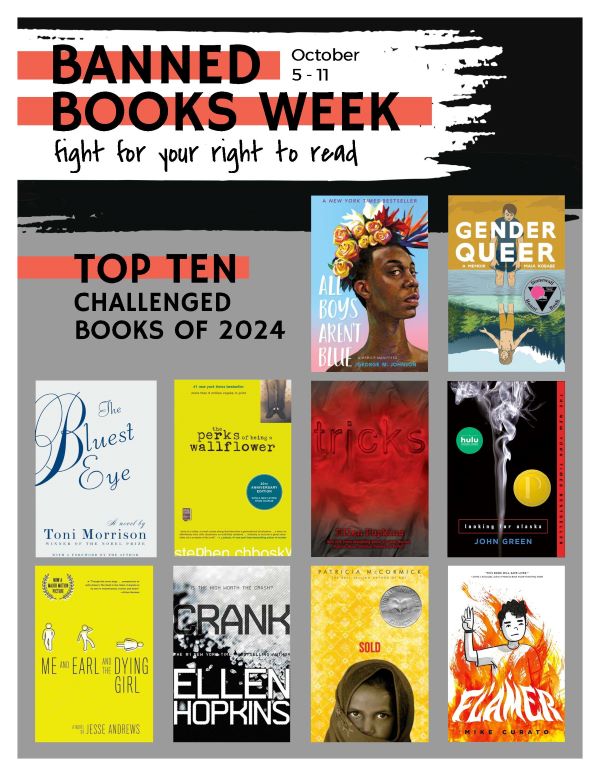
Below are the Top 10 Most Challenged Books of 2024, as recorded by the American Library Association:
(click the tiltles to search the McCracken County Public Library catalog)
- All Boys Aren’t Blue by George M. Johnson
Why this book matters: bit.ly/allboysBR - Gender Queer by Maia Kobabe
Why this book matters: bit.ly/genderBR - (TIE) The Bluest Eye by Toni Morrison
Why this book matters: bit.ly/bluestBR - (TIE) The Perks of Being a Wallflower by Stephen Chbosky
Why this book matters: bit.ly/wallflowerBR - Tricks by Ellen Hopkins
Why this book matters: bit.ly/tricksBR - (TIE) Looking for Alaska by John Green
Why this book matters: bit.ly/alaskaBR - (TIE) Me and Earl and the Dying Girl by Jesse Andrews
Why this book matters: bit.ly/earlBR - (TIE) Crank by Ellen Hopkins
Why this book matters: bit.ly/crankBR - (TIE) Sold by Patricia McCormick
Why this book matters: bit.ly/soldBR - Flamer by Mike Curato
Why this book matters: bit.ly/flamerBR
The most common justifications for censorship provided by complainants were false claims of illegal obscenity for minors; inclusion of LGBTQIA+ characters or themes; and covering topics of race, racism, equity, and social justice.